

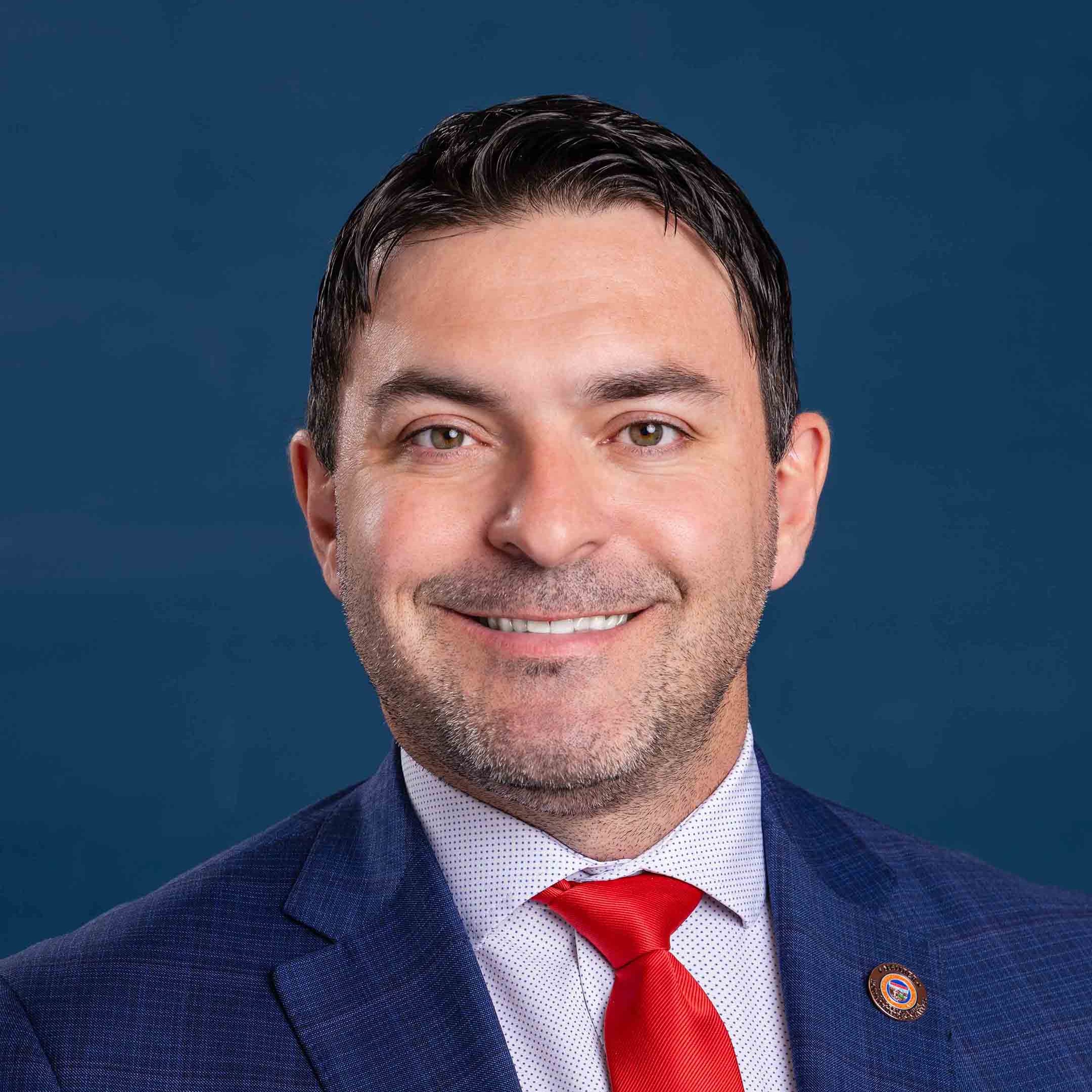
Photo of Leo Biasiucci
R Arizona House · District 30

Rep. Leo Biasiucci

Compare
Total votes
5,339
all sessions
Attendance
98%
115 missed
Near the chamber average
With party
96%
of cast votes
Near the chamber average
Bipartisan score
4%
crosses aisle rarely
Near the chamber average
Sponsored
731
bills & resolutions
Near the chamber average
Committees
4
assignments
731 bills and resolutions

Sponsored bills

Total
731
Primary
175
Co-sponsor
556
This page
731
matching current filters
Primary HB 2769
Signed into law · Arizona House · Lead sponsor
state land transfer; Bullhead City

Maddy summaryHB 2769 transfers four specific parcels of state-owned land in Mohave County (adjacent to the Colorado River) from Arizona's state land department to the city of Bullhead City. The bill directs the state land commissioner to deliver a deed to Bullhead City within 10 days of the law's effective date. The transferred land must be managed permanently by the city for public parks and recreation purposes and cannot be sold or exchanged. This procedural bill (passed March 27, 2025, and signed April 1, 2025) directly affects Bullhead City's land holdings and future public space development.

Signed into law Apr 1, 2025 0 co-sponsors
Co-sponsor HCR 2022
Passed · Arizona House · Co-sponsor
nuclear energy; Palo Verde; support

Maddy summaryThis is a symbolic resolution (not a law) passed by Arizona lawmakers expressing support for the Palo Verde Generating Station nuclear power plant and nuclear energy. It highlights Palo Verde's role as Arizona's largest clean energy source, economic contributor ($2.3 billion impact), and employer (3,000+ jobs), while noting public support for nuclear power. The resolution has no legal effect but formally endorses continued nuclear energy use and directs the Secretary of State to send copies to federal officials. It does not create new policies, funding, or regulations.

Passed Apr 1, 2025 1 co-sponsor
Co-sponsor HB 2320
Passed · Arizona House · Co-sponsor
appropriation; veterans' services; mental health

Maddy summaryHB 2320 appropriates $1 million from the consumer restitution fund for Arizona's Department of Veterans' Services to provide grants to nonprofit organizations. These grants fund trauma-informed mental health services - including clinical care, physical training, nutritional guidance, and peer outreach - for veterans (of all eras and discharge statuses), active duty service members, and their families dealing with conditions like PTSD, depression, anxiety, or substance use disorders. Nonprofits must partner with Arizona hospitals and universities to deliver these services statewide. The funding is exempt from standard appropriation lapse rules, ensuring consistent support for these programs.

Passed Apr 1, 2025 1 co-sponsor
Co-sponsor HB 2557
Passed · Arizona House · Co-sponsor
appropriation; State Route 347; widening

Maddy summaryHB 2557 appropriates $16,291,610 from Arizona's state general fund for fiscal year 2025-2026 to the Department of Transportation. The funds are specifically designated to widen and improve State Route 347 between Interstate 10 and the city of Maricopa. This project directly affects drivers and local communities along that corridor by expanding the highway infrastructure. The bill creates no new regulations or requirements - its sole mechanism is the allocation of funds for this physical improvement project.

Passed Apr 1, 2025 1 co-sponsor
Co-sponsor HB 2855
Passed · Arizona House · Co-sponsor
terrorist organizations; drug cartels

Maddy summaryHB 2855 declares that drug cartels operating in Arizona are terrorist organizations under state law. It defines "drug cartel" to include groups involved in human smuggling, drug trafficking, or terrorism, and requires the Arizona Department of Homeland Security to address the threat they pose. The bill explicitly states this definition does not affect individuals' claims for asylum under federal law. This legislation aims to empower state agencies to combat border-related criminal activity, based on voter-approved findings about public safety concerns linked to transnational cartels.

Passed Mar 31, 2025 1 co-sponsor
Co-sponsor HB 2404
Passed · Arizona House · Co-sponsor
commerce authority; board of directors

Maddy summaryHB 2404 establishes the Arizona Commerce Authority to lead economic growth by attracting, expanding, and retaining businesses across the state. It creates a 19-member board of directors (including the governor as chair, 17 private business leaders appointed by the governor and legislative leaders, and non-voting ex officio members) to guide this work. Key provisions require appointed board members to undergo criminal background checks, mandate technical advisors from state agencies (like environmental quality and transportation), and set annual audit requirements for the authority’s funds. The bill directly affects state economic development strategy and business recruitment efforts, with the board’s decisions shaping how Arizona markets itself to companies.

Passed Mar 31, 2025 1 co-sponsor
Co-sponsor HB 2384
Passed · Arizona House · Co-sponsor
fire insurance; wildfire risk modeling

Maddy summaryHB 2384 requires Arizona insurers to use wildfire risk modeling for fire insurance policies in cities and towns with fewer than 150,000 residents. It mandates that insurers base premiums on community-level wildfire mitigation efforts, specifically rewarding properties in "Firewise USA Site" communities that have implemented proven safety measures. This policy change directly affects homeowners in smaller Arizona communities and insurers operating there, shifting how wildfire risk is assessed from individual properties to community-wide safety programs. The law aims to incentivize community-wide wildfire preparedness by offering lower insurance rates to areas with certified mitigation efforts.

Passed Mar 31, 2025 1 co-sponsor
Primary HB 2720
Signed into law · Arizona House · Lead sponsor
hydrolyzed cocaine; threshold amount

Maddy summaryThis bill amends Arizona's definition of "dangerous drug" to include specific synthetic compounds under new categories, such as cannabimimetic substances (e.g., JWH-018, JWH-073) and other listed chemicals. It directly affects individuals possessing or using these substances, as it establishes legal thresholds for enforcement under Arizona law. The key provision redefines "dangerous drug" to explicitly cover these synthetic compounds, including their salts, isomers, and derivatives, without exception. This change clarifies legal boundaries for law enforcement and pharmacists (referencing the Arizona State Board of Pharmacy) regarding these substances. Note: The bill's title mentions "hydrolyzed cocaine," but the actual text focuses on defining dangerous drugs, not hydrolyzed cocaine.

Signed into law Mar 31, 2025 0 co-sponsors
Primary HB 2108
Signed into law · Arizona House · Lead sponsor
communications from inmate; victims' right

Maddy summaryHB 2108 requires Arizona prosecutors to notify crime victims within 15 days of sentencing or commitment that they can request to block all communication (mail, email, phone calls) from the offender. This applies to both juvenile offenders (under A.R.S. § 8-392.01) and adult inmates (under A.R.S. § 13-4411.01), directly affecting victims and their families or household members who make such requests. Correctional departments must enforce these blocks by not forwarding prohibited communications and imposing sanctions like loss of earned release credits if offenders violate the request. The law also prohibits inmates from contacting communication service providers or remote computing services, with departments reviewing outgoing mail to ensure compliance.

Signed into law Mar 31, 2025 0 co-sponsors
Co-sponsor SB 1312
Passed · Arizona Senate · Co-sponsor
coordinated reentry; grants; appropriation

Maddy summarySB 1312 creates a state-funded program to help people transitioning from county jails back into communities. It provides $20 million in grants to Arizona counties (excluding Maricopa and Pima) to establish coordinated reentry planning services in jails, connecting individuals with treatment, housing, and other support services early in the justice process. Key requirements include creating a cross-system database to track recidivism and service engagement, forming collaborative planning committees with law enforcement, courts, and service providers, and submitting annual reports on participant risks (like homelessness or lack of healthcare) and repeat offenses. Counties must demonstrate program implementation within two years of receiving funds, including dedicated staff and data-sharing agreements.

Passed Mar 26, 2025 1 co-sponsor
Showing 131 to 140 of 731 bills
Previous 1 … 13 14 15 … 74 Next