

Maddy summaryHB 2502 requires Arizona employers to provide employees with a 30-minute unpaid meal break after five hours of work (and an additional break after twelve hours), plus a paid 10-minute rest break for every four hours worked. It mandates 1.5 times regular pay for hours worked beyond eight in a workday (up to twelve hours) or the first eight hours on a seventh consecutive workday, and double pay for hours beyond twelve in a day or eight on the seventh consecutive workday. The bill applies to employers meeting the federal threshold of $100,000 annual sales or engaging in interstate commerce, ensuring Arizona’s labor standards align with the federal Fair Labor Standards Act. This directly affects most Arizona employers and their hourly workers by modifying break requirements and overtime compensation rates.
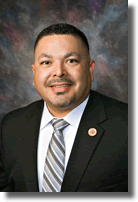
Sponsored bills
Maddy summaryHB 2501 repeals Arizona's right-to-work law (ARS 23-1302), which currently prohibits employers from requiring union membership or dues as a condition of employment. The bill also amends related statutes to remove references to the repealed law, including adjustments to civil liability for employment violations and protections against retaliatory termination. However, the bill will not take effect unless voters approve a constitutional amendment for right-to-work at the next general election. This repeal would directly affect workers, employers, and labor unions by eliminating a key restriction on union security agreements.
Maddy summaryHB 2531 creates a new "community college access and success" special license plate program for Arizona vehicle owners. Community college districts must pay a one-time $32,000 fee to the state to implement the program. Once approved, vehicle owners can purchase these plates for a $25 annual fee, with $17 of that amount donated to the community college district. The plates will feature a design similar to historic collegiate plates (pre-1993) and may be personalized with an additional fee.
Maddy summaryHB 2337 repeals Arizona laws that prevented cities and counties from enacting their own rent control regulations. This bill removes state-level restrictions on local rent regulation, specifically repealing Sections 33-1329 and 33-1416 of the Arizona Revised Statutes. By eliminating this preemption, the bill would allow municipalities to establish their own tenant protection policies without state interference. The change directly affects local governments and renters in communities that may choose to implement new rent control measures.
Maddy summaryHB 2359 prohibits healthcare professionals from providing conversion therapy to minors under 18, defining conversion therapy as any practice seeking to change a minor's sexual orientation or gender identity. The bill exempts clergy acting in a pastoral role and parents who are healthcare professionals acting as parents, not professionals. It also bans state and federal funds from being used for conversion therapy for minors, including through grants, contracts, or health benefits coverage. The law directly affects licensed therapists, state agencies, and entities receiving public funds by restricting both clinical services and financial support for this practice.
Maddy summaryThis bill amends the powers and duties of the Arizona Department of Health Services director, specifically expanding authority to inspect premises and vehicles for health violations. It allows the director to enter a wider range of locations, including restaurants and factories, to enforce health laws and requires public hearings before leasing state hospital property to third parties. Additionally, the legislation grants the director flexibility to delegate certain functions to local health agencies and establish emergency measures for controlling infectious diseases. The changes aim to streamline public health enforcement and improve the management of state hospital assets without altering the core structure of the department.
Maddy summarySB 1018 amends state law to update how the Arizona State Board of Equalization calculates spending limits for school districts and other political subdivisions. The bill requires the commission to determine these limits annually based on population growth and changes in the GDP price deflator, which measures inflation. It also provides specific formulas for setting limits in new cities, towns, or counties that are created or divided. By adjusting these calculations, the legislation ensures that spending caps reflect current economic conditions and demographic shifts rather than fixed historical figures.