

Maddy summaryHB 2144 amends Arizona's child support law to require courts to consider the mother's direct medical and pregnancy-related expenses when determining child support for a preborn child (unborn child). This affects child support cases where the child has not yet been born, ensuring pregnancy costs are factored into support calculations. The key mechanism adds this as a new factor (item 9) under the existing guidelines for determining support amounts. The bill does not change other child support rules but specifically addresses pregnancy-related medical expenses for the mother.
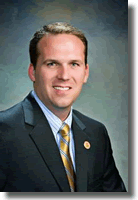
Rep. Justin Olson
Sponsored bills
Maddy summaryHB 2289 requires Arizona school districts to hold voter elections when proposed budgets exceed legal limits, mandating they create an alternate budget without excessive increases. It directs school superintendents to prepare an informational pamphlet for voters containing specific details: the election date, proposed tax impacts for different property types (e.g., average homes, half-value homes, businesses), and a neutral summary of how funds will be used. The pamphlet must also include up to 10 factual arguments for and against the budget increase, verified by the superintendent to correct inaccuracies. This directly affects school districts, voters deciding on budget approvals, and property owners who see tax impact calculations in the pamphlet.
Maddy summarySB 1010 renames Arizona's Loop 202 highway as the "Charlie Kirk Highway" in honor of Charlie Kirk. The bill requires the Arizona Department of Transportation to update all official documents, records, and signage to include this new name while maintaining existing designations. It affects public records and highway signage for Loop 202, with no changes to the highway's physical structure or function. This is a ceremonial designation with no substantive policy changes.
Maddy summaryHB 4029 requires Arizona's governor and legislature to annually evaluate whether aligning state income tax laws with federal tax code changes would impact state revenue by $100 million or more. If so, the governor must notify legislative leaders by September 30 on whether a special session is needed to adjust state law. The bill also creates two new simplified tax forms for eligible individual taxpayers (e.g., those using optional tax tables or claiming basic deductions) and mandates electronic filing for tax preparers handling over 10 annual returns, with limited exemptions for those lacking computer or internet access. These changes directly affect Arizona taxpayers, preparers, and the state budget process.
Maddy summaryHB 2784 is a technical correction to Arizona Revised Statutes Section 9-237, which specifies the required officers for towns. The amendment fixes a punctuation error in the list of officers to clearly state that towns must appoint a town clerk, town marshal, and town engineer, along with other necessary officers as determined by the common council. This change clarifies existing requirements without altering the substance of the law or affecting any policy outcomes. It directly affects all Arizona towns that must appoint these officers under state law.
Maddy summaryHB 4027 renames Arizona's Loop 202 highway as the "Charlie Kirk Highway" for official records and signage. The bill requires all state documents, records, and transportation department signage to include the new name after enactment, without replacing any existing designations. This is a ceremonial procedural bill with no policy or funding changes.
Maddy summaryHB 4103 modifies Arizona school district bond election rules by requiring districts to calculate enrollment capacity using a new method. It directly affects school districts with enrollment below a threshold defined as their average daily student count divided by the maximum student capacity of their academic buildings (excluding administrative/storage space). The bill mandates annual calculations of this capacity based on academic square footage per facility guidelines, preventing districts from holding bond elections or altering capital projects if capacity falls below the threshold. This policy change focuses on ensuring bond decisions align with actual classroom space availability.
Maddy summaryHB 2993 amends Arizona law to clarify when state agencies can hire their own legal counsel. Typically, agencies must use the Attorney General's office for legal representation, but exceptions allow them to hire outside lawyers if the Attorney General is disqualified (e.g., due to a conflict of interest) or in specific cases like pesticide complaints involving the Department of Agriculture. The bill also requires agencies with their own legal divisions (funded by non-general revenue) to reimburse the state general fund for legal services provided by the Attorney General. This affects all state agencies, including the Department of Public Safety (DPS), by defining their legal representation options and reimbursement obligations.
Maddy summaryHCR 2052 is a proposed voter referendum that would impose a temporary freeze on municipal and county fee, tax, and utility rate increases in Arizona. It would prohibit cities and counties from raising these charges above 2025-2026 budget levels from July 2026 through June 2030, covering fees for services, permits, utility rates, and transaction taxes. Exceptions include voter-approved increases meeting specific criteria (60% approval in even-year elections). If approved by voters, the freeze would take effect on July 1, 2026, and expire on June 30, 2030. This measure directly affects local governments and residents/businesses paying municipal or county fees and services.
Maddy summaryHB 4030 imposes a 4-year freeze (2026-2030) on most fee, tax, and utility rate increases for Arizona cities and counties. It prohibits local governments from raising fees above 2025-2026 budget levels, increasing transaction taxes beyond current rates, or creating new tax classifications, while banning tactics like renaming fees to bypass the rule. Exceptions include voter-approved tax hikes requiring 60%+ support in even-year elections. The bill directly affects all municipal and county budgets, with enforcement allowing affected residents or businesses to seek court action for violations. It covers fees for permits, services, utilities, and development, but does not restrict fee reductions or rate increases due to higher demand.