

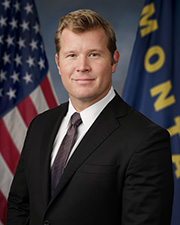
Photo of Tim Sheehy
R United States Senate · Montana

Sen. Tim Sheehy

Compare
Total votes
440
all sessions
Attendance
99%
6 missed
Near the chamber average
With party
99%
of cast votes
Higher than 83% of chamber peers
Bipartisan score
0%
crosses aisle rarely
Lower than 85% of chamber peers
Sponsored
403
bills & resolutions
Near the chamber average
Committees
9
assignments
403 bills and resolutions

Sponsored bills

Total
403
Primary
75
Co-sponsor
328
This page
403
matching current filters
Co-sponsor S 3916
In committee · Alaska Senate · Co-sponsor
Gun Owner Registration Information Protection Act

Maddy summaryThe Gun Owner Registration Information Protection Act (S 3916) prohibits federal funding for state or local databases that track lawfully owned firearms or their owners. It defines such databases as those listing firearms possessed by individuals or the individuals themselves who legally own firearms. The bill allows federal funding for databases tracking lost or stolen firearms and their owners, but not for general ownership records. This would require states and localities to cover costs for firearms ownership databases using non-federal funds, shifting financial responsibility away from federal support.

In committee Feb 25, 2026 1 co-sponsor
Primary S 3899
In committee · Alaska Senate · Lead sponsor
Maverick Act

Maddy summaryThe Maverick Act (S 3899) authorizes the U.S. Navy to transfer F-14 Tomcat aircraft to the U.S. Space and Rocket Center Commission in Huntsville, Alabama, for public display and educational purposes. The bill allows the Navy to transfer the aircraft via sale, gift, or loan, with requirements for demilitarization and restrictions on further use. The Commission must cover all costs for restoration, operation, maintenance, and compliance, with the transfer occurring at no cost to the federal government. This bill directly affects the Huntsville museum and focuses on preserving naval aviation heritage through public access.

In committee Feb 24, 2026 0 co-sponsors
Co-sponsor S 2503
Failed · Alaska Senate · Co-sponsor
ROTOR Act

Rotorcraft Operations Transparency and Oversight Reform Act or the ROTOR Act This bill addresses aviation safety by increasing requirements for aircraft tracking and communication using Automatic Dependent Surveillance-Broadcast (ADS-B) technology and expanding oversight. As background, ADS-B for broadcasting (Out) and receiving (In) transmits information (e.g., location and weather information) between aircraft and air traffic control. Under the bill, aircraft must generally operate with ADS-B In equipment to provide the aircraft with location information of other aircraft and traffic advisories. Current law does not require this equipment. Current Federal Aviation Administration (FAA) regulations allow aircraft performing a sensitive government mission to be excepted from requirements for using ADS-B Out equipment. This bill limits which flights may be considered sensitive government missions (e.g., not training flights) and requires additional reporting and notifications for the exception. The Government Accountability Office must review the use of the ADS-B Out exception and the Office of the Inspector General (OIG) of the Department of Transportation must annually audit FAA oversight of operations that use the exception. Further, the bill repeals a 2025 law that exempts certain military helicopters from the ADS-B Out requirements for the Washington, DC, metropolitan area. The bill also requires the OIG of the Army to audit the Army’s coordination with the FAA, the FAA to establish an office to coordinate airspace usage of military aircraft and review the safety of flight operations and routes around airports, and the FAA to enter into memoranda of understanding with military agencies for safety information sharing.

Failed Feb 24, 2026 1 co-sponsor
Co-sponsor S 3866
In committee · Alaska Senate · Co-sponsor
A bill to provide for updates to the Federal Aviation Administration type certification process to support development of new and novel technologies, and for other purposes.

Maddy summaryThis bill (S 3866) updates the Federal Aviation Administration’s (FAA) aircraft type certification process to accelerate approval for new aviation technologies like air taxis and advanced air mobility vehicles. It directly affects aircraft manufacturers, FAA staff, and infrastructure providers (such as vertiport operators) by requiring the FAA to publish clear timelines for certification milestones and establish standardized criteria for when the FAA issues formal "issue papers" about safety concerns. Key mechanisms include mandating a public transparency plan within 180 days, setting standard expected timelines for key certification steps (like responses to industry requests), and revising delegation rules to improve efficiency while maintaining safety. The bill aims to reduce delays for innovative aircraft without compromising safety standards, focusing on predictable processes for emerging technologies.

In committee Feb 12, 2026 1 co-sponsor
Primary S 2860
In committee · Alaska Senate · Lead sponsor
Revitalizing America’s Offshore Critical Minerals Dominance Act

Maddy summaryS 2860 (Revitalizing America’s Offshore Critical Minerals Dominance Act) aims to accelerate U.S. development of seabed mineral resources on the Outer Continental Shelf. It directs federal agencies to expedite permits for exploration and commercial recovery of critical minerals like nickel, cobalt, and rare earth elements - key for defense, energy, and manufacturing - while requiring a seabed mapping plan and identifying minerals essential for national security. The bill also mandates coordination with allies to support international partnerships for seabed mineral development and environmental monitoring. This primarily affects U.S. companies seeking seabed mineral rights and federal agencies managing offshore resources.

In committee Feb 12, 2026 0 co-sponsors
Co-sponsor S 472
In committee · Alaska Senate · Co-sponsor
Ski Hill Resources for Economic Development Act

Ski Hill Resources for Economic Development Act This bill allows National Forest System (NFS) units to keep the majority of ski area permit rental fees that were generated within their boundaries and outlines how revenues from those fees may be used. Such fees are collected by the Department of Agriculture (USDA) from ski area operators on NFS land. Within the NFS unit where the fees were generated, USDA must expend (1) 60%-48% of the collected fees for activities such as administration of the ski area permit program, visitor information, or reducing the likelihood of wildfire in or adjacent to a recreation site; and (2) 20% of the collected fees for activities such as repair of a Forest Service-owned facility, habitat restoration, or search and rescue activities. The remainder of the collected fees must be expended by USDA at any NFS unit for any of the activities specified in this bill.

In committee Feb 11, 2026 1 co-sponsor
Co-sponsor S 362
In committee · Alaska Senate · Co-sponsor
A bill to allow certain Federal minerals to be mined consistent with the Bull Mountains Mining Plan Modification, and for other purposes.

This bill authorizes coal to be mined on approximately 800 acres of federal land in Musselshell County, Montana. Specifically, it allows all federal coal reserves in such federal land and leased under Federal Coal Lease MTM 97988 to be mined in accordance with the 2020 Bull Mountains Mining Plan Modification. The Bull Mountains Mine is operated by Signal Peak Energy. This bill directs the Department of the Interior, without modification or delay, to approve the Bull Mountains Mining Plan Modification to the extent necessary to mine such land.

In committee Feb 11, 2026 1 co-sponsor
Co-sponsor SRES 601
Passed · Alaska Senate · Co-sponsor
A resolution designating the week beginning February 2, 2026, as "National Tribal Colleges and Universities Week".

Maddy summaryThis Senate resolution (SRES 601) designates the week beginning February 2, 2026, as "National Tribal Colleges and Universities Week" to recognize these institutions' role in serving Native communities and their economic contributions. It highlights that tribal colleges serve students from over 250 federally recognized tribes, offer culturally grounded education, and contribute $3.8 billion annually to the U.S. economy. As a symbolic resolution (not a law), it has no binding effect but calls for public observance through community activities. The resolution focuses on honoring tribal colleges' mission and achievements, citing their open enrollment and economic impact statistics.

Passed Feb 5, 2026 1 co-sponsor
Primary S 3778
In committee · Alaska Senate · Lead sponsor
Carbon Resource Innovation Act

Maddy summaryThe Carbon Resource Innovation Act (S 3778) expands a federal tax credit to include businesses capturing carbon in solid or liquid form, directly affecting companies building carbon capture facilities. It modifies the existing 45Q tax credit to cover facilities that capture carbon that would otherwise be released into the atmosphere, requiring measurement at the capture source and verification at disposal. The bill sets a minimum annual capture threshold of 1,000 metric tons for these facilities and defines "solid or liquid carbon capture facility" to include systems with net carbon reductions compared to standard processes. This change aims to incentivize broader carbon capture technology adoption beyond current direct air capture methods.

In committee Feb 4, 2026 0 co-sponsors
Primary S 3728
In committee · Alaska Senate · Lead sponsor
Long-Distance Corridor Relief Enhancement Act

Maddy summaryThis bill modifies a federal requirement for selecting rail corridors by exempting long-distance passenger rail routes from needing committed or anticipated non-Federal funding. It directly affects intercity passenger rail corridors on long-distance routes accepted into the program after October 1, 2023. The key provision removes the Secretary's obligation to consider non-Federal funding when selecting these specific corridors under the program described in the law. This change simplifies the selection process for qualifying long-distance rail corridors by eliminating a prior funding requirement.

In committee Jan 29, 2026 0 co-sponsors
Showing 121 to 130 of 403 bills
Previous 1 12 13 14 41 Next