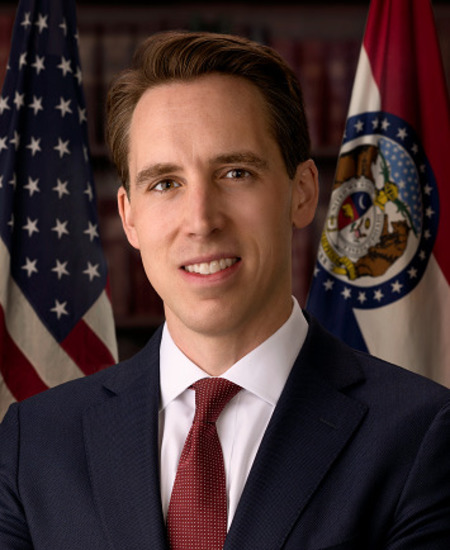
Photo of Josh Hawley
R United States Senate · Missouri

Sen. Josh Hawley

Compare
Total votes
1,037
all sessions
Attendance
97%
30 missed
Near the chamber average
With party
86%
of cast votes
Lower than 96% of chamber peers
Bipartisan score
7%
crosses aisle rarely
Higher than 92% of chamber peers
Sponsored
854
bills & resolutions
Lower than 89% of chamber peers
Committees
12
assignments
854 bills and resolutions

Sponsored bills

Total
854
Primary
154
Co-sponsor
700
This page
854
matching current filters
Co-sponsor S 2371
In committee · Alaska Senate · Co-sponsor
Safe Baby Formula Act of 2025

Maddy summaryS 2371, the Safe Baby Formula Act of 2025, requires the U.S. Department of Health and Human Services (HHS) to study the health impacts of arsenic, cadmium, mercury, and lead in infant formula within one year of enactment. Within 90 days of the bill becoming law, HHS must establish either enforceable action levels or formal maximum contamination limits for these toxic metals in infant formula. The bill directly affects infant formula manufacturers and distributors, who will need to comply with the new safety standards. The law defines "infant formula" using the existing federal definition under the Federal Food, Drug, and Cosmetic Act.

In committee Jul 22, 2025 1 co-sponsor
Co-sponsor S 2376
In committee · Alaska Senate · Co-sponsor
A bill to amend title 18, United States Code, to include rioting in the definition of racketeering activity.

Maddy summaryThis bill amends federal law to include rioting as a form of "racketeering activity" under the Racketeer Influenced and Corrupt Organizations (RICO) Act. It does so by adding a reference to section 2101 (which defines rioting as a federal crime) into the existing list of racketeering activities. This change would allow federal prosecutors to pursue RICO charges against individuals or groups who engage in rioting as part of a larger pattern of organized criminal conduct. The bill directly affects those whose rioting activities are linked to organized criminal enterprises, potentially subjecting them to enhanced penalties under RICO.

In committee Jul 22, 2025 1 co-sponsor
Primary SRES 327
In committee · Alaska Senate · Lead sponsor
A resolution condemning the persecution of Christians in Muslim-majority countries and encouraging the President to prioritize the protection of persecuted Christians in United States foreign policy.

Maddy summarySRES 327 is a non-binding Senate resolution condemning the persecution of Christians in Muslim-majority countries and urging the President to prioritize their protection in U.S. foreign policy. It specifically encourages diplomatic engagement with Muslim-majority nations and the use of trade and security negotiations to advance protections for Christians facing violence, discrimination, or legal barriers in countries like Nigeria, Pakistan, Egypt, and Iran. The resolution does not create new laws or funding but formally expresses congressional concern and directs the executive branch to address these issues through existing diplomatic channels. It affects U.S. foreign policy implementation but has no direct impact on affected communities or legislation.

In committee Jul 21, 2025 0 co-sponsors
Co-sponsor S 2362
In committee · Alaska Senate · Co-sponsor
Ending Lending to China Act of 2025

Maddy summaryS 2362, the Ending Lending to China Act of 2025, directs the U.S. Treasury to instruct American representatives at multilateral development banks (like the World Bank and Asian Development Bank) to oppose all new loans and financial assistance to China. It targets China specifically because the bill states China has "graduated" from needing such aid (exceeding the income threshold for borrowing since 2016). The bill requires the Treasury to submit annual reports to Congress on China’s borrowing status, voting power at these banks, and efforts to encourage other countries to graduate from borrowing eligibility. This legislation changes U.S. voting policy at these institutions but does not alter China’s actual eligibility or stop existing loans.

In committee Jul 21, 2025 1 co-sponsor
Primary S 2367
In committee · Alaska Senate · Lead sponsor
AI Accountability and Personal Data Protection Act

Maddy summaryThis bill creates a federal private right of action for individuals whose "covered data" (including personal information, biometrics, location data, and inferred profiles) is used without their clear, upfront permission. It requires explicit consent for data collection, processing, or sharing with third parties, mandating specific disclosures separate from general terms. Individuals can sue for damages (minimum $1,000 per violation), punitive damages, or injunctions, and the law invalidates pre-dispute arbitration agreements for these claims. The bill does not override stricter state privacy laws but establishes a baseline federal standard for data misuse by AI systems and data processors.

In committee Jul 21, 2025 0 co-sponsors
Co-sponsor S 2305
In committee · Alaska Senate · Co-sponsor
FRONT Act

Maddy summaryThis bill requires certain U.S. tax-exempt nonprofits receiving funding from governments or entities of specific "foreign countries of concern" (including China, Russia, Iran, Cuba, Venezuela, and North Korea) to register as foreign agents under the Foreign Agents Registration Act. It mandates detailed reporting about foreign-funded activities, including copies of agreements or full statements of activities, and prohibits exemptions that normally apply to lobbying or humanitarian fundraising groups. The law directly affects nonprofits organized under Section 501(c) of the Internal Revenue Code that accept money or resources from these designated foreign governments or entities. Key provisions include defining "foreign country of concern" and specifying the exact information nonprofits must disclose to the government. The bill takes effect 30 days after enactment.

In committee Jul 16, 2025 1 co-sponsor
Co-sponsor S 331
Signed into law · Alaska Senate · Co-sponsor
HALT Fentanyl Act

Halt All Lethal Trafficking of Fentanyl Act or the HALT Fentanyl Act This act permanently places fentanyl-related substances as a class into schedule I of the Controlled Substances Act. A schedule I controlled substance is a drug, substance, or chemical that has a high potential for abuse; has no currently accepted medical value; and is subject to regulatory controls and administrative, civil, and criminal penalties under the Controlled Substances Act. Under the act, offenses involving fentanyl-related substances are triggered by the same quantity thresholds and subject to the same penalties as offenses involving fentanyl analogues (e.g., offenses involving 100 grams or more trigger a 10-year mandatory minimum prison term). Additionally, the act establishes a new, alternative registration process for certain schedule I research. The act also makes several other changes to registration requirements for conducting research with controlled substances, including permitting a single registration for related research sites in certain circumstances, waiving the requirement for a new inspection in certain situations, and allowing a registered researcher to perform certain manufacturing activities with small quantities of a substance without obtaining a manufacturing registration. Finally, the act expresses the sense that Congress agrees with the interpretation of the Controlled Substances Act in United States v. McCray , a 2018 case decided by the U.S. District Court for the Western District of New York. In that case, the court held that butyryl fentanyl, a controlled substance, can be considered an analogue of fentanyl even though, under the Controlled Substances Act, the term controlled substance analogue specifically excludes a controlled substance.


Signed into law Jul 16, 2025 1 co-sponsor
Co-sponsor S 2294
In committee · Alaska Senate · Co-sponsor
Kay Hagan Tick Reauthorization Act

Maddy summaryThis bill reauthorizes federal funding for tick-borne disease programs under the Public Health Service Act. It reduces annual funding levels for two key programs: $8 million per year (from $10 million) for the National Strategy and Regional Centers of Excellence (2026-2030), and $19 million per year (from $20 million) for health department support programs (2026-2030). These changes extend existing programs through 2030 with adjusted funding amounts. The bill directly affects public health programs and state/local health departments addressing tick-borne diseases like Lyme disease.

In committee Jul 15, 2025 1 co-sponsor
Co-sponsor S 2278
In committee · Alaska Senate · Co-sponsor
Graham Hoffman Act

Maddy summaryThis bill creates a new federal crime for assaulting first responders (like police, firefighters, and paramedics) causing serious injury or death, with enhanced penalties. It specifically applies when the assault involves interstate travel, weapons that crossed state lines, or interference with the responder's work affecting commerce. Penalties include up to 10 years in prison for serious injury, or life imprisonment if death occurs, kidnapping, or an attempt to kill happens. Federal prosecution requires Attorney General certification unless states decline jurisdiction or fail to adequately address the crime.

In committee Jul 15, 2025 1 co-sponsor
Co-sponsor S 2276
In committee · Alaska Senate · Co-sponsor
ETHIC Act

Maddy summaryThe ETHIC Act (S 2276) limits patent holders from asserting multiple related patents against generic drug and biosimilar manufacturers. It restricts claims to one patent per "Patent Group" (defined as commonly owned patents linked through specific disclaimer filings) in infringement lawsuits involving drug/biosimilar applicants. This applies to cases related to FDA applications under 505(b)(2), 505(j), or 351(k) pathways for new drug approvals. The law aims to reduce legal barriers for competition by preventing patent thickets from delaying generic/biosimilar market entry.

In committee Jul 15, 2025 1 co-sponsor
Showing 101 to 110 of 854 bills
Previous 1 10 11 12 86 Next