

Assault Weapons Ban of 2021 This bill makes it a crime to knowingly import, sell, manufacture, transfer, or possess a semiautomatic assault weapon (SAW) or large capacity ammunition feeding device (LCAFD). The prohibition does not apply to a firearm that is (1) manually operated by bolt, pump, lever, or slide action; (2) permanently inoperable; (3) an antique; or (4) a rifle or shotgun specifically identified by make and model. The bill also exempts from the prohibition the following, with respect to a SAW or LCAFD: importation, sale, manufacture, transfer, or possession related to certain law enforcement efforts, or authorized tests or experiments; importation, sale, transfer, or possession related to securing nuclear materials; and possession by a retired law enforcement officer. The bill permits continued possession, sale, or transfer of a grandfathered SAW, which must be securely stored. A licensed gun dealer must conduct a background check prior to the sale or transfer of a grandfathered SAW between private parties. The bill permits continued possession of, but prohibits sale or transfer of, a grandfathered LCAFD. Newly manufactured LCAFDs must display serial number identification. Newly manufactured SAWs and LCAFDs must display the date of manufacture. The bill also allows a state or local government to use Edward Byrne Memorial Justice Assistance Grant Program funds to compensate individuals who surrender a SAW or LCAFD under a buy-back program.
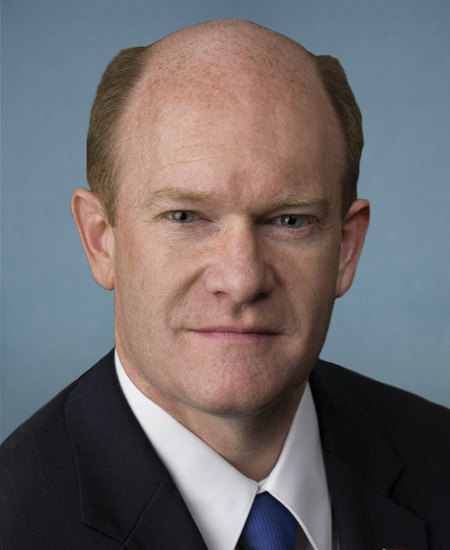
Sen. Christopher A. Coons
Sponsored bills
Work Opportunities and Resources to Keep Nonprofit Organizations Well Act or the WORK NOW Act This bill requires the Department of the Treasury to establish a grant program to provide emergency relief to certain nonprofit organizations, prioritizing organizations that provide services related to the COVID-19 (i.e., coronavirus disease 2019) pandemic. Organizations receiving funding must use not less than 60% of these funds to hire former and new employees.
This resolution recognizes the centennial of the Tulsa Race Massacre of 1921. The resolution acknowledges the historical significance of this event as one of the largest single instances of state-sanctioned violence against Black people in American history; honors the lives and legacies of the estimated 300 Black individuals who were killed during the massacre and the nearly 9,000 who were left homeless and penniless; condemns efforts to cover up the truth and shield the white community, especially government officials, from accountability; condemns the continued legacy of racism and white supremacy against Black people in the United States, particularly in the form of police brutality; encourages education about the massacre, the history of white supremacy that fueled the massacre, and subsequent attempts to deny or cover up the massacre, in all elementary and secondary education settings and in institutions of higher education; and recognizes the commitment of Congress to acknowledge and learn from the history of racism and racial violence to reverse the legacy of white supremacy and fight for racial justice.
NICS Denial Notification Act of 2021 This bill requires the Department of Justice to notify state and local law enforcement authorities following a firearms-related background check that results in a denial.
Strengthening and Amplifying Vaccination Efforts to Locally Immunize all Veterans and Every Spouse Act or the SAVE LIVES Act This bill authorizes the Department of Veterans Affairs (VA) to furnish a COVID-19 (i.e., coronavirus disease 2019) vaccine to covered individuals during the COVID-19 public health emergency. Under the bill, covered individuals are veterans who are not eligible to enroll in the VA health care system; specified veterans who are eligible for hospital care, medical services, and nursing home care abroad; beneficiaries who are eligible for care due to a specified disability or death of a veteran; family caregivers of veterans who are participating in the VA's Program of Comprehensive Assistance for Family Caregivers; caregivers of veterans participating in the VA's Program of General Caregiver Support Services; caregivers of veterans participating in the VA's Medical Foster Home Program, Bowel and Bladder Program, Home Based Primary Care Program, or Veteran Directed Care Program; and the spouses of veterans. The VA must prioritize the vaccination of (1) veterans who are enrolled in the VA health care system, (2) veterans who fail to enroll but receive hospital care and medical services for specified disabilities in their first 12 months of separation from service, and (3) caregivers accompanying such prioritized veterans. Under the bill, the VA is authorized to offer a vaccine to the spouse of a veteran near the same time the veteran receives the vaccine.
This resolution encourages (1) the people of the United States to join in a national effort to salute AmeriCorps members, alumni, and Americorps Seniors volunteers and to raise awareness about the importance of national and community service; and (2) all individuals to consider opportunities to serve in AmeriCorps and Americorps Seniors. The resolution also acknowledges the accomplishments of AmeriCorps members, alumni, community partners, and Americorps Seniors volunteers and recognizes their important contributions to the lives of the people of the United States.
Supporting Early-Career Researchers Act This bill authorizes the National Science Foundation (NSF) to establish a two-year pilot program to award grants to highly qualified early-career investigators to carry out an independent research program at the institution of higher education chosen by such investigator, to last for a period not greater than two years. In awarding grants, the NSF shall give priority to (1) early-career investigators who are from groups that are underrepresented in scientific research, and (2) early-career investigators who choose to carry out independent research at a minority-serving institution.
Universal Giving Pandemic Response and Recovery Act This bill allows individual taxpayers who do not otherwise itemize their tax deductions a deduction in taxable years beginning in 2021 or 2022 for charitable contributions. The deduction is limited to one-third of the standard deduction allowed to such taxpayers.
End Racial and Religious Profiling Act of 2021 or ERRPA This bill establishes a framework to eliminate racial profiling at the federal, state, and local levels. Specifically, it requires federal law enforcement agencies to maintain policies and procedures to eliminate racial profiling, including training, data collection, and complaint procedures. State, local, and tribal law enforcement agencies must maintain similar policies and procedures as a condition of receiving funds under the Edward Byrne Memorial Justice Assistance Grant program and the Community Oriented Policing Services program. To enforce violations, the bill authorizes civil suits by the Department of Justice and affected individuals.
Stop Forced Organ Harvesting Act of 2021 This bill establishes specified measures to combat forced organ harvesting and the international trafficking in persons for the purpose of removing their organs. These measures include (1) establishing property-blocking and visa-blocking sanctions, (2) prohibiting exports of certain surgery devices to entities that are identified as being responsible for forced organ harvesting or related human trafficking, and (3) requiring the Department of State to report on these practices.