

Child Welfare Provider Inclusion Act of 2021 This bill generally prohibits the federal government, states, tribal nations, or localities from discriminating or taking adverse action against a child welfare provider that declines to provide services due to the provider's sincerely held religious beliefs or moral convictions. However, government entities may still take adverse action against a provider that declines to provide adoption or foster care services based on race, color, or national origin. The Department of Health and Human Services must withhold a portion of federal funding for family services and child welfare activities from a government entity that discriminates against a child welfare provider in violation of this bill. Child welfare providers may also sue the government entity for such discrimination. A prevailing provider may recover reasonable attorney's fees and costs. Furthermore, government entities that accept certain federal funding for family services and child welfare activities must waive sovereign immunity as a defense to lawsuits brought under this bill. (In many cases, sovereign immunity shields states, territories, tribal nations, and some localities against private suits.)
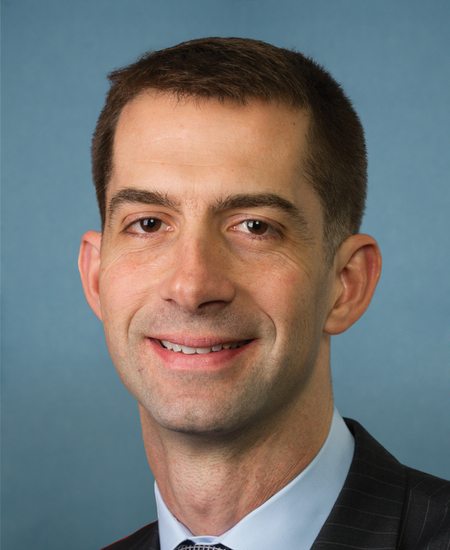
Sen. Tom Cotton
Sponsored bills
Defending Our Defenders Act This bill establishes federal criminal offenses involving the murder of federal, state, or local law enforcement officers. Violators are subject to life in prison or death. The bill sets forth aggravating factors (e.g., intent to ambush or prior history of promoting violence against a law enforcement officer) to be considered in determining whether to impose the death penalty.
Death Tax Repeal Act of 2021 This bill repeals the estate and generation-skipping transfer taxes. It also makes conforming amendments related to the gift tax.
Significant Transnational Criminal Organization Designation Act This bill makes membership in a significant transnational criminal organization a ground for inadmissibility into the United States and provides for criminal penalties against those that provide material support to such an organization. The bar against admission applies to an alien member of such an organization and an alien spouse or child of such an individual. The bar shall not apply to a spouse or child who (1) did not know, or should not reasonably have known, that the individual was a member of such an organization; or (2) has renounced the organization in question. The bill establishes statutory authority and procedures for the Department of Justice to designate an organization a significant transnational criminal organization. The Department of the Treasury may require U.S. financial institutions to block transactions involving assets belonging to such an organization. An individual who knowingly provides material support or resources to a significant transnational criminal organization (or attempts or conspires to do so) shall be fined, imprisoned for up to 20 years, or both. If the death of any person is the result, the offending individual may be imprisoned for any term of years or for life. A financial institution that becomes aware that it possesses or controls funds belonging to such an organization shall retain such funds and notify Treasury.
Stop Forced Organ Harvesting Act of 2021 This bill establishes specified measures to combat forced organ harvesting and the international trafficking in persons for the purpose of removing their organs. These measures include (1) establishing property-blocking and visa-blocking sanctions, (2) prohibiting exports of certain surgery devices to entities that are identified as being responsible for forced organ harvesting or related human trafficking, and (3) requiring the Department of State to report on these practices.
Keeping Critical Connections Act of 2021 This bill provides funds with which the Federal Communications Commission shall reimburse small business broadband providers for costs incurred during the COVID-19 (i.e., coronavirus disease 2019) emergency period to voluntarily (1) provide free or discounted service to students in need of distance learning capacity, or (2) refrain from disconnecting low-income households that cannot afford to make a full payment.
Entity List Verification Act This bill prohibits the Department of Commerce from removing an entity from the entity list until Commerce makes certain certifications. The entity list provides the names of foreign entities who are subject to specific license requirements for the export, reexport, or transfer of specified items. Commerce may not remove an entity from the entity list until Commerce certifies that (1) the entity is no longer involved in activities that are contrary to U.S. national security or foreign policy interests, and (2) removing the entity from the list does not pose a threat to U.S. allies.
American Financial Markets Integrity and Security Act This bill generally prohibits investments in certain Chinese military companies and entities reasonably believed to be involved in activities contrary to the national security or foreign policy interests of the United States. These entities may not sell securities to U.S. markets. Investment companies, insurance companies, and retirement plans are prohibited from investing in these entities. The bill also prohibits the use of federal funds to enter into or renew a contract with these entities. Furthermore, the Department of Commerce and the Office of the Director of National Intelligence—in addition to the Department of Defense as under current law—are allowed to add entities to the list of Chinese military companies.
Foreign Influence Transparency Act This bill addresses foreign influence in higher education and in certain other academic, religious, and artistic pursuits. Current law exempts from foreign agent registration requirements a person engaging in activities in furtherance of religious, scholastic, academic, or scientific pursuits or of the fine arts. The bill specifies that this exemption applies only to those activities that do not promote the political agenda of a foreign government. Under current law, an institution of higher education (IHE) must disclose to the Department of Education (ED) a gift or contract that is from a foreign source and is valued at $250,000 or more, considered alone or in combination with all other gifts from or contracts with the foreign source. The bill instead requires an IHE to disclose such a gift or contract that is valued at $50,000 or more, considered alone or in combination with all other gifts or contracts. An IHE must include in its disclosure report the contents of any such contract and make the contents available for public disclosure. Additionally, an IHE that enters into an agreement with a Confucius Institute (i.e., a cultural institute directly or indirectly funded by the Chinese government) must immediately make available the full text of the agreement to the public, ED, and Congress. Finally, the bill prohibits an IHE that does not comply with these disclosure requirements from enrolling foreign students under the Student and Exchange Visitor Program.
This bill eliminates the Office of Financial Research, which provides financial data and analysis to support the Financial Stability Oversight Council.