Plain Prescription Prices Act This bill requires the Centers for Medicare & Medicaid Services to issue a rule requiring direct-to-consumer television advertisements for prescription drugs that are covered by Medicare or Medicaid to include a textual statement of the drug's list price.
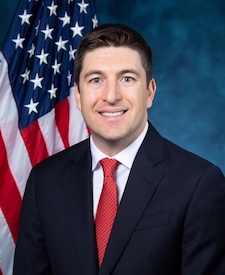
Rep. Bryan Steil
Sponsored bills
Public Health and Border Security Act of 2022 This bill requires the Department of Health and Human Services (HHS) to meet conditions related to notification and planning before terminating certain restrictions on imports and individuals entering the United States. Current law authorizes HHS to restrict entries and imports from foreign countries to prevent the introduction of communicable diseases. HHS exercised this authority as part of its COVID-19 response, including to allow for the expulsion of undocumented migrants at the border without any asylum processing. Under this bill, HHS may not terminate the restrictions for (1) at least 60 days after it notifies Congress of the end of the COVID-19 emergency, and (2) at least 30 days after it submits to Congress a plan for addressing the possible influx of migrants or imports resulting from lifting the restrictions.

Competency-Based Education Act of 2022 or the CBE Act of 2022 This bill creates a framework under which students participating in competency-based education programs may receive federal student aid. Competency-based education refers to education that measures academic progress and attainment (1) by direct assessment of the student's mastery of competencies, (2) by expressing the student's mastery of competencies in terms of equivalent credit or clock hours, or (3) through a combination of both methods in addition to credit or clock hours. The bill also prohibits the Department of Education from enforcing certain regulations related to the definition of credit hour.
Volunteer Driver Tax Appreciation Act of 2022 This bill increases the mileage rate for the charitable use of an automobile (14 cents per mile) to the standard business mileage rate (58.5 cents per mile in 2022).
Transparency in CFPB Cost-Benefit Analysis Act This bill sets forth information required to be included in a rulemaking made by the Consumer Financial Protection Bureau (CFPB). Specifically, the CFPB must publish a justification of the proposed rulemaking; a quantitative and qualitative assessment of all anticipated direct and indirect costs and benefits; alternatives to the proposed rulemaking; impacts on small businesses; and any assumptions, data, or studies used in preparing this information.
SEC Economic Analysis Modernization Act This bill requires the Securities and Exchange Commission to periodically update its guidance on the use of economic analysis in rulemakings and to make such updates publicly available.
Ensuring Lasting Smiles Act This bill requires private health insurance plans to cover diagnosis and treatment of congenital anomalies and birth defects, such as reconstructive services and items. Coverage must include services and items that functionally improve, repair, or restore any body part that is medically necessary for normal bodily functions or appearance, as determined by the treating physician. Coverage limits and cost-sharing requirements for such services and items may not be more restrictive than those applicable to all medical and surgical benefits under the plan.
Supply Chain Disruptions Relief Act This bill modifies the treatment of liquidations of new motor vehicle inventory as qualified LIFO (last in first out accounting method) inventory. It allows new motor vehicle dealers to elect to wait until the end of 2025 to replace their inventory for purposes of determining income attributable to the sale of such inventory during 2020 and 2021.
Protecting Rural Renters Act of 2022 This bill prevents the reallocation of unspent funding that states and territories received through the Emergency Rental Assistance program. This program provides funding to assist low-income households affected by the COVID-19 pandemic with covering unmet rent and utility expenses. Cities and counties with populations over 200,000 may elect to receive funding directly, while states and territories receive the funding to administer assistance in all other areas. Under current law, if a jurisdiction fails to spend a minimum portion of its funds by a statutory deadline, the Department of the Treasury must reallocate those funds among jurisdictions that spent more than a specified portion of their initial allocation. The bill prohibits Treasury from reallocating unspent funds received by states and territories and requires Treasury to return to a state or territory any funds previously reallocated.
Anti-Border Corruption Improvement Act This bill revises the waiver authority of the U.S. Customs and Border Protection (CBP) for polygraph examinations of applicants for law enforcement positions in the CBP. Any individual who receives such a waiver and holds a current background investigation may be subject to further background investigation. The CBP may administer a polygraph examination to an applicant for employment or an employee who is eligible for a waiver if information is discovered prior to the completion of a background investigation that makes necessary a final determination regarding suitability for employment or continued employment.