Pretrial Release Reporting Act This bill requires the Bureau of Justice Statistics to submit a report to Congress on individuals who are granted bail or pretrial release from state courts and are charged with violent felony offenses (e.g., murder or rape).
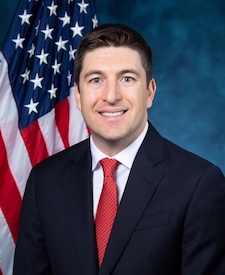
Rep. Bryan Steil
Sponsored bills
Porch Pirates Act of 2022 This bill extends federal criminal penalties for obstruction of correspondence and theft of stolen mail matter (which apply to U.S. Postal Service mail) to matter (e.g., packages) sent or delivered by private or commercial interstate carriers.
Upholding the Law at Our Border Act This bill requires the Office of Inspector General of the Department of Homeland Security (DHS) to periodically investigate and report on certain issues until there have been fewer than 35,000 apprehensions at the southwest border for three consecutive months. When required, the reports must address certain issues, including (1) the vetting procedures applicable to aliens seeking entry into the United States who were apprehended along the southwest border, (2) the total number of individuals not lawfully present who have been processed and released into the United States, (3) the number of such individuals who have received parole, and (4) an audit of the parole applications. The office must submit such reports (and provide briefings on the reports) to the President, Congress, DHS, and the Department of Justice.
Halt All Lethal Trafficking of Fentanyl Act or the HALT Fentanyl Act This bill places fentanyl-related substances as a class into schedule I of the Controlled Substances Act. A schedule I controlled substance is a drug, substance, or chemical that has a high potential for abuse; has no currently accepted medical value; and is subject to regulatory controls and administrative, civil, and criminal penalties under the Controlled Substances Act. Additionally, the bill establishes a new, alternative registration process for schedule I research that is funded by the Department of Health and Human Services or the Department of Veterans Affairs or that is conducted under an investigative new drug exemption from the Food and Drug Administration. The bill also makes several other changes to registration requirements for conducting research with controlled substances, including permitting a single registration for related research sites in certain circumstances, waiving the requirement for a new inspection in certain situations, and allowing a registered researcher to perform certain manufacturing activities with small quantities of a substance without obtaining a manufacturing registration.
Illegal Immigrant Payoff Prohibition Act This bill prohibits the payment of a settlement to an alien for a civil action brought against the United States in connection with the alien's inadmissibility to, or unlawful presence in, the United States.
Stop Settlement Slush Funds Act of 2021 This bill prohibits the federal government from entering into or enforcing a settlement agreement on behalf of the United States that provides for a payment to any person or entity other than the United States. The bill provides exceptions to allow payments that (1) remedy actual harm (including to the environment) caused by the party making the payment, or (2) constitute a payment for services rendered in connection with the case. Government officials or agents who violate this prohibition may be removed from office or required to forfeit to the government any money they hold for such purposes to which they may otherwise be entitled. Agencies must report annually for seven years to the Congressional Budget Office about the parties, funding sources, and distribution of funds for their settlement agreements permitted by the exceptions in this bill. The Office of Inspector General for each agency must also report annually on any settlement agreements that violate the bill's requirements.
Firearm Due Process Protection Act This bill expands the grounds for pursuing judicial remedies related to certain firearm transfers. Additionally, the bill establishes procedural rules applicable to actions for judicial remedies. Current law authorizes judicial remedies for an individual who is erroneously denied a firearm (e.g., an individual is denied a firearm but the individual is eligible to receive or possess a firearm). This bill authorizes remedies for an individual who experiences an extended delay (i.e., a delay of more than 60 days) on a firearm transfer. Additionally, the bill requires an expedited hearing on an action for judicial remedies and places the burden of proof on the respondent to show by clear and convincing evidence that the individual was ineligible to receive or possess a firearm.

Global Malnutrition Prevention and Treatment Act of 2021 This act sets out programs and otherwise directs the U.S. Agency for International Development (USAID) to carry out activities to prevent and treat malnutrition globally. Specifically, USAID may leverage resources to address malnutrition through the Global Nutrition Coordination Plan (an interagency effort to strengthen the impact of U.S. investments in nutrition) and its role on the board of directors of the U.S. International Development Finance Corporation. USAID must also select countries based on specified malnutrition-related indicators for purposes of targeting malnutrition prevention and treatment programs and update the selection within five years. Additionally, USAID may establish the Nutrition Leadership Council to coordinate federal government activities to prevent and treat malnutrition; and target resources and nutrition interventions to the populations most susceptible to severe malnutrition and otherwise support efforts to prevent and treat malnutrition globally. The act also requires USAID to provide to Congress an implementation plan and annual reports concerning its programs for treating and preventing malnutrition. The act's provisions terminate seven years after its enactment.
Simplifying Grants Act of 2022 This bill sets forth procedures for simplifying the grant process for nonurbanized areas, for both existing and new grant programs. Each agency must make publicly available a checklist for covered local governments with respect to each grant program of the agency for which such governments are otherwise eligible that includes each requirement for every step of the grant process. The Office of Management and Budget must report to Congress (1) within 270 days of this bill's enactment, evaluating the extent to which agencies have simplified the requirements and made the checklist available; and (2) each April 1st, evaluating the amount of technical assistance provided and the amount of funds awarded.
Russia and Belarus SDR Exchange Prohibition Act of 2022 This act prohibits the Department of the Treasury from engaging in any transaction involving the exchange of Special Drawing Rights (SDRs) held by Russia or Belarus and requires Treasury to take actions to oppose financial assistance to Russia or Belarus. The SDR is an international reserve asset maintained by the International Monetary Fund (IMF) based on contributions from IMF member countries. SDRs may be exchanged between member countries and may also be exchanged for currencies. Treasury must also (1) vigorously advocate for IMF member countries to prohibit transactions involving the exchange of SDRs held by Russia or Belarus, and (2) direct U.S. representatives to each international financial institution to oppose providing financial assistance to Russia or Belarus except to address the basic human needs of their civilian populations. The act's provisions shall be in effect until the earlier of (1) five years after this act's enactment, or (2) 30 days after the President reports to Congress that the governments of Russia and Belarus have ceased destabilizing activities directed at Ukraine's sovereignty and territorial integrity. The President may also waive the provisions upon reporting to Congress that doing so is in the national interest of the United States.