

This resolution expresses the sense of the House of Representatives that former President Trump did not engage in insurrection or rebellion against, nor give aid or comfort to the enemies of, the United States.
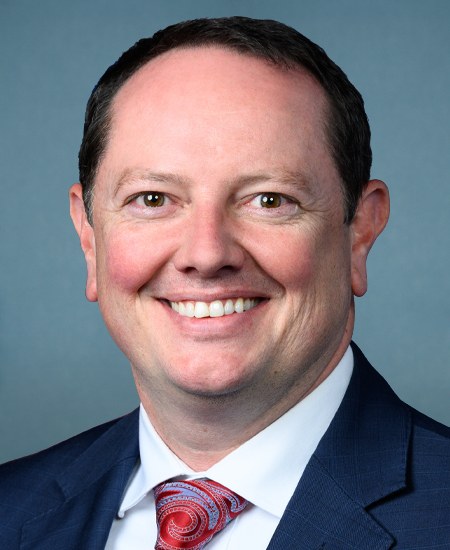
Rep. Eric Burlison
Sponsored bills
Maddy summaryHJRES 107 is a congressional resolution seeking to block a Federal Communications Commission (FCC) rule published on January 22, 2024 (89 Fed. Reg. 4128). The resolution aims to disapprove the FCC's rule implementing digital discrimination protections under the Infrastructure Investment and Jobs Act, which would have required internet providers to prevent discriminatory practices. If passed, this resolution would nullify the FCC rule, preventing it from taking effect under the Congressional Review Act (Chapter 8 of Title 5, U.S. Code). The bill directly affects the FCC's regulatory authority over digital discrimination enforcement in broadband services.
Maddy summaryHR 7183, the PROTECTS Act of 2024, prohibits federal funding from being used to provide or refer for specific gender transition procedures to individuals under 18. The bill defines prohibited procedures broadly to include surgeries (like hysterectomy, mastectomy, or genital reconstruction), puberty-blocking medications, and hormone treatments administered at supraphysiologic doses. It includes limited exceptions for medically necessary care, such as treating precocious puberty or correcting genetic disorders of sex development. The law directly affects minors seeking gender-affirming medical care covered by federal programs, restricting federal financial support for these services.
Maddy summaryHR 7117, the Driver Data Control Act of 2024, limits access to data from vehicle safety recorders (EDRs) to protect owners' privacy. It requires federal law enforcement to obtain a warrant, court order (with 48-hour owner notice), or use data solely for emergency medical care in crashes. The bill prohibits insurers, lienholders, and lessors from accessing EDR data without written owner consent, banning conditions that tie insurance claims, payments, or lease agreements to data access. This directly affects vehicle owners, law enforcement, and insurance/leasing companies by establishing clear consent rules and restricting data use.
Maddy summaryThis bill repeals a law (18 U.S.C. § 1715) that previously prohibited mailing firearms without a license. It directly affects the U.S. Postal Service, firearm sellers, and individuals mailing firearms by preventing the Postal Service from creating rules that would block firearm mailings or require disclosure of sensitive records like sales receipts or firearm serial numbers. Key provisions include removing the existing ban on mailing firearms and prohibiting the Postal Service from imposing new restrictions on firearm mailings or demanding customer transaction data. The bill ensures that firearm mailings can proceed without these specific federal restrictions, while applying to ongoing legal cases under the repealed law.
Maddy summaryThis bill prohibits the EPA from finalizing, implementing, or enforcing the December 13, 2023, proposed rule on water pollution standards for meat and poultry processing facilities under the Clean Water Act. It directly affects meat and poultry processing plants by blocking a specific EPA regulation that would have set new wastewater discharge limits. The key provision explicitly bans the EPA from moving forward with this rule or any "substantially similar" rule. The bill does not create new regulations but stops a specific EPA action from taking effect.
Maddy summaryHR 7083, the RAZOR Act, prohibits federal agencies from removing or altering barriers (like fences or fences) built by states along the U.S. border to prevent unlawful crossings. It directly affects federal departments and agencies, such as the Department of Homeland Security, by restricting their ability to modify state-constructed border infrastructure. The key provision is a clear ban on any federal action that would change or remove these state-built barriers. This bill makes a specific policy change regarding federal-state border infrastructure authority without altering broader immigration law.
Ultrasound Informed Consent Act This bill requires abortion providers to conduct an ultrasound before performing an abortion. Specifically, before a woman gives informed consent to any part of an abortion, the abortion provider must perform an obstetric ultrasound on the pregnant woman; provide a simultaneous explanation of what the ultrasound is depicting; display the ultrasound images so the woman may view them; and provide a complete medical description of the images, including the dimensions of the embryo or fetus, cardiac activity if present and visible, and the presence of external members and internal organs if present and viewable. Providers are subject to civil actions and penalties for violations. The bill's ultrasound requirements do not apply in cases where a physical disorder, illness, or injury caused by the pregnancy endangers a woman's life. A woman is also not required to view the ultrasound images; nor may she or the provider be penalized if she declines to do so.
Maddy summaryThis bill establishes a 60-day deadline for filing lawsuits challenging federal permits for dredged or fill material under the Clean Water Act. It explicitly excludes reviews of state permit programs from this timeline and requires courts to remand non-compliant permits to agencies within 180 days, rather than vacating them. Courts may only block a permit if activities under it pose an "imminent and substantial danger" to health or the environment with no other remedy. The law directly affects permit applicants, federal agencies (like the Army Corps of Engineers), and state programs approved under the Clean Water Act.
Maddy summaryHR 6967, the Safe Airspace for Americans Act, requires the Federal Aviation Administration (FAA) to establish standardized procedures for reporting and investigating incidents involving unidentified anomalous phenomena (UAPs) reported by aviation personnel, including pilots, air traffic controllers, and maintenance staff. Key provisions include creating a dedicated reporting system (either updating an existing program or launching a new one), mandating data archiving for investigations, and prohibiting retaliation against employees who report UAPs. The bill explicitly protects pilots’ medical and airman certificates from being negatively impacted by UAP reports and bans employers from taking adverse personnel actions against staff for reporting such incidents. This directly affects aviation workers who witness UAPs by ensuring their reports are handled systematically and without professional penalty.