

Maddy summaryHR 24, the Federal Reserve Transparency Act of 2025, mandates a comprehensive audit of the Federal Reserve Board and Federal Reserve banks by the Government Accountability Office (GAO) within 12 months of enactment. The bill requires the GAO to submit a detailed report to Congress within 90 days of completing the audit, including findings, conclusions, and recommendations for legislative or administrative action. This audit replaces current limitations on reviewing Federal Reserve operations, particularly regarding entities like special purpose vehicles not previously subject to standard audits. The bill directly affects the Federal Reserve System by increasing congressional oversight of its financial activities and reporting mechanisms.
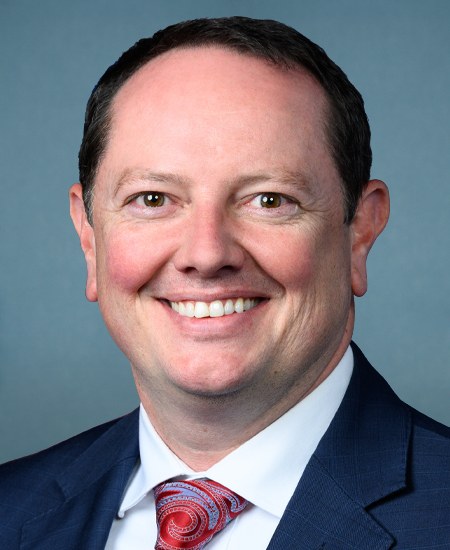
Rep. Eric Burlison
Sponsored bills
Maddy summaryHR 191, titled "Inflation Reduction Act of 2025," is a procedural bill that repeals the Inflation Reduction Act of 2022 (Public Law 117-169) and rescinds its unobligated funds. It directly affects the implementation of the 2022 law by nullifying its provisions and redirecting any remaining unspent budget authority. The bill contains no new policy mechanisms or direct impacts on citizens or programs; its sole action is to undo the previous legislation. This is a straightforward repeal measure with no new funding or regulatory changes. The title is misleading, as the bill does not create a new inflation reduction policy but instead reverses the prior law.
Maddy summaryThe FairTax Act of 2025 would repeal federal income tax, payroll taxes (Social Security and Medicare), and estate and gift taxes, replacing them with a national sales tax. It would impose a 23% tax on the final consumption of goods and services in 2027, with rates adjusting based on federal tax rates. The bill includes a monthly rebate for qualifying families based on the poverty level to offset the tax burden on lower-income households. It would establish a cooperative tax administration system between federal and state governments, with states collecting the tax under certain conditions. The tax would sunset if the 16th Amendment (which allows for income taxes) is not repealed within 7 years of enactment.
Maddy summaryHR 45 (FIND Act) requires federal government contractors to certify they do not discriminate against firearm businesses (including manufacturers, dealers, and trade associations) in their policies or practices. The bill mandates that contractors and subcontractors (for contracts over 10% of the prime contract value) certify they have no discriminatory policies and will not adopt them during the contract term. Violations could lead to contract termination and potential debarment. This applies to all federal procurement contracts awarded after the bill's enactment, excluding sole-source contracts. The law aims to ensure firearm businesses are treated equally in government contracting without restricting legitimate business criteria like creditworthiness or legal compliance.
Maddy summaryHR 74, the Freedom for Families Act, modifies health savings account (HSA) rules to benefit individuals providing care for family members. It allows tax-free HSA distributions during "qualified caregiving" periods (defined as leave under the Family and Medical Leave Act), removes the requirement to have a high-deductible health plan to qualify for an HSA, and increases the annual HSA contribution limit to $9,000 ($18,000 for joint returns). These changes directly affect HSA account holders, particularly those taking leave to care for family members or managing healthcare costs. The bill focuses on expanding access to tax-advantaged savings for healthcare and caregiving expenses.
Maddy summaryHR 48, the Ultrasound Informed Consent Act, requires abortion providers performing an abortion to first conduct an ultrasound, explain the images, display them to the patient, and describe key details like embryo/fetus size, heartbeat (if visible), and organ development. It applies to all abortion providers in interstate commerce, directly affecting patients seeking abortions and the providers who perform them. The bill includes an exception for medical emergencies endangering the mother’s life, and explicitly allows patients to decline viewing the images without penalty. Violations could result in civil fines up to $250,000 per incident or patient lawsuits for damages.
Maddy summaryHR 10549, the Sovereign State Environmental Quality Assurance Act, would abolish the Environmental Protection Agency (EPA) 270 days after enactment, requiring the EPA Administrator to wind up operations and submit a progress report within 90 days. It redirects $4.4 billion annually (2026-2029) to state environmental departments based on population, plus $880 million yearly for Treasury oversight. The Congressional Budget Office must also conduct annual efficacy studies and reports on the Act during the same funding period. This bill directly affects all 50 states, the District of Columbia, Puerto Rico, and U.S. territories by shifting federal environmental funding and oversight authority to state-level agencies.
Maddy summaryHJRES 229 proposes a constitutional amendment requiring U.S. federal spending (outlays) to never exceed revenue (receipts) except through debt that adheres to strict limits. It sets an initial debt limit at 105% of current debt, requiring state legislatures to approve any increase above this limit via a simple majority vote within 60 days. If debt exceeds 98% of the limit, the President must automatically order spending cuts to comply, with Congress able to override only through a concurrent resolution. This amendment would directly affect all federal budget decisions, tax policies, and debt management, applying immediately upon ratification.
Maddy summaryThis bill would prevent the EPA from enforcing regulations that could force premature shutdowns of reliable coal and natural gas power plants. It requires the EPA to halt enforcement of such rules until the North American Electric Reliability Corporation (NERC) confirms the grid is operating with sufficient reliability ("Normal Risk" per NERC's 2023 assessment). The bill specifically targets EPA proposals like the greenhouse gas standards for power plants, aiming to avoid electricity shortages by preserving existing reliable generation capacity. It does not create new regulations but blocks enforcement of current proposals pending grid reliability assessments.
Maddy summaryHR 7513, the Protecting America’s Seniors’ Access to Care Act, prohibits the Department of Health and Human Services from implementing or enforcing a proposed rule that would have set minimum staffing requirements for nursing homes and other long-term care facilities receiving Medicare or Medicaid funding. The bill specifically blocks the September 2023 proposed rule (88 Fed. Reg. 61352-61429) and any substantially similar rule. This directly affects long-term care facilities that rely on federal healthcare program payments. The key mechanism is a clear statutory prohibition preventing the rule from taking effect, without altering existing staffing standards or requirements.