

Conservatorships Immoral Relationship with Contraception in the United States Act or the CIRCUS Act This bill excludes from participation in federal health care programs providers who (1) require the approval of the conservator before removing a contraceptive device from an individual under a conservatorship, or (2) prescribe birth control medications to an individual under a conservatorship without that individual's written consent.
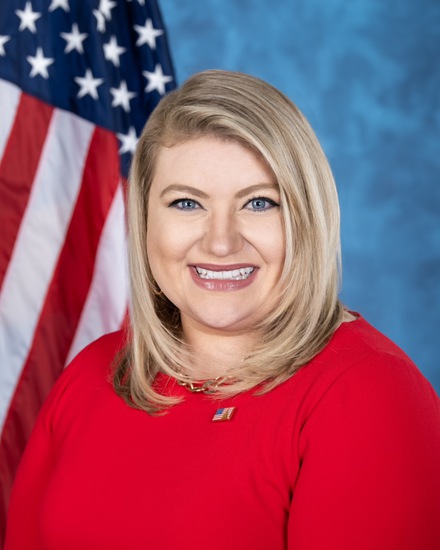
Rep. Kat Cammack
Sponsored bills
This resolution expresses the sense of the House of Representatives that the Department of Homeland Security (DHS) provides essential protection for our country from foreign and domestic threats and that defunding DHS would be detrimental to our national security.
This resolution recognizes and expresses support for the efforts of democracy and human rights activists in Cuba.
Broadband for Rural America Act This bill modifies and consolidates Department of Agriculture (USDA) programs for expanding broadband internet in rural areas. Specifically, the bill modifies a program that provides grants, loans, and loan guarantees to support broadband expansion in rural areas. Modifications include revising the criteria used to prioritize applications and projects and changing the name of the program to the ReConnect Rural Broadband Program. Additionally, the bill terminates on June 30, 2022, a Department of Agriculture (USDA) COVID-19 response program that supports broadband expansion in rural areas for distance learning and telemedicine. Any remaining program funds available after the termination date shall be used for the ReConnect Rural Broadband Program. The bill also expands coordination requirements that apply to the Department of Commerce, USDA, the Federal Communications Commission (FCC), and the National Telecommunications and Information Administration. This includes requiring the use of specified FCC maps when assessing a community's access to broadband.
SNAP Reform Act of 2021 This bill modifies eligibility under the Supplemental Nutrition Assistance Program (SNAP) with respect to individuals who receive other forms of assistance. Currently, households may be considered categorically eligible for SNAP if all members receive certain other assistance, such as under the Temporary Assistance for Needy Families (TANF) program. The bill specifies that members receiving TANF assistance must (1) receive at least $150 a month in cash assistance under TANF for an extended period with an income of up to 130% of the federal poverty level (FPL), or (2) be elderly or disabled and receive cash assistance or ongoing and substantial services under TANF with an income of up to 200% of the FPL. The bill also increases the maximum allowable resources for SNAP eligibility and specifies that certain allowances relating to energy assistance extend only to households with elderly members.
This resolution mourns the death of Frederick Stephen Humphries, former president of Florida A&M University and Tennessee State University, and requests that a copy of this resolution be transmitted to his family.
This resolution requires an analytical statement to be included in committee reports on whether, and the extent to which, the increased budget authority, outlays, or revenue produced by the enactment of a bill or joint resolution may have an inflationary impact on prices and costs in the operation of the national economy and the purchasing power of low- and middle-income families.
Foreign Gain-of-Function Research Prevention Act of 2021 This bill prohibits the use of federal funds to conduct or support gain-of-function research involving potential pandemic pathogens by China, Russia, Iran, North Korea, or other foreign adversaries. Gain-of-function research is any research that is anticipated to confer an attribute on a pathogen to enhance its pathogenicity or transmissibility in mammals. If the Department of State finds that an entity has used funds for prohibited research, the entity may not receive any federal funding for a period of five years.
Campus Free Speech Restoration Act This bill addresses expressive activities (e.g., peacefully assembling, distributing literature, or carrying signs) on college campuses. First, the bill generally prohibits a public institution of higher education (IHE) that participates in federal student-aid programs from restricting noncommercial expressive activities on campus. Further, the bill prohibits a public IHE from receiving federal funds if the Department of Education determines that the public IHE (1) maintains a policy that infringes upon the expressive rights of students; or (2) maintains or enforces time, place, or manner restrictions on expressive activities, except in limited circumstances. In addition, the bill prohibits retaliation against an individual because the individual reported or complained about restrictions on expressive activities or participated in an investigation or hearing. The bill also requires a private IHE that receives federal funds to provide students with its policies related to expressive rights. The bill also establishes a framework for investigating complaints and for IHEs to regain eligibility for federal funds.