

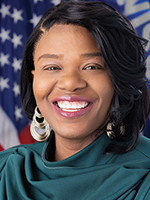
Photo of Sequanna Taylor
D Wisconsin House · District 11 On the 2026 ballot

Rep. Sequanna Taylor

Compare
Total votes
219
all sessions
Attendance
89%
26 missed
Near the chamber average
With party
95%
of cast votes
Near the chamber average
Bipartisan score
2%
crosses aisle rarely
Near the chamber average
Sponsored
187
bills & resolutions
Near the chamber average
Committees
4
assignments
187 bills and resolutions

Sponsored bills

Total
187
Primary
187
Co-sponsor
0
This page
187
matching current filters
Primary AB 1060
Failed · Wisconsin House · Lead sponsor
Relating to: grants for falls prevention awareness and initiatives and making an appropriation. (FE)

Maddy summaryAB 1060 allocates $450,000 annually for two fiscal years (2025-26 and 2026-27) to fund falls prevention awareness and initiatives in Wisconsin. The bill directs the Department of Health Services to award this grant specifically to the Wisconsin Institute for Healthy Aging. This funding supports statewide programs aimed at reducing fall-related injuries, primarily affecting older adults in the state. The bill makes a concrete budget adjustment to enable this grant without altering existing health service programs.

Failed Apr 13, 2026 0 co-sponsors
Primary AB 790
Failed · Wisconsin House · Lead sponsor
Relating to: creating the water fund for our future, granting rule-making authority, and making an appropriation. (FE)

Maddy summaryAB 790 creates a dedicated "Water Fund for Our Future" with an initial $250 million transfer from the general fund. The fund establishes a rapid response account to cover clean water-related costs during natural disasters or public health emergencies, including remediation and assistance for affected individuals. A new joint committee oversees fund spending, reviewing requests for funding (excluding non-clean-water uses) and recommending approvals to the finance committee. All funds must be used exclusively for clean water activities, with specific rules for disbursement and oversight.

Failed Apr 13, 2026 0 co-sponsors
Primary AB 1203
Failed · Wisconsin House · Lead sponsor
Relating to: net zero emissions, carbon-free and renewable energy standards, and creating an office of sustainability and clean energy, granting rule-making authority, making an appropriation, and providing a penalty. (FE)

Maddy summaryThis bill establishes a comprehensive clean energy framework requiring Wisconsin to achieve 100 percent clean electricity production and net-zero carbon emissions by 2050. It creates a new Office of Sustainability and Clean Energy within the Department of Administration to develop and update an economy-wide decarbonization roadmap using sector-based modeling. The legislation sets specific interim targets for carbon-free electricity, including 50 percent by 2030, 65 percent by 2035, 80 percent by 2040, 90 percent by 2045, and full carbon-free status by 2050. State agencies must consider purchasing renewable energy from providers with long-term contracts, though the requirements do not apply if generation is not technically feasible or cost-effective. The bill also provides funding for technology implementation and defines carbon-free resources to include hydroelectric power alongside other renewable sources.

Failed Apr 9, 2026 0 co-sponsors
Primary AB 1226
Failed · Wisconsin House · Lead sponsor
Relating to: the fee for filing limited liability company articles of organization with the Department of Financial Institutions. (FE)

Maddy summaryThis bill exempts youth entrepreneurs aged 12 to 17 from paying filing fees when forming a limited liability company in Wisconsin. It applies specifically to LLCs where all members are youth entrepreneurs or where all organizers who become members are youth entrepreneurs. The Department of Financial Institutions would no longer collect the standard filing fee for these qualifying youth-led businesses. The law takes effect on the first day of the second month after publication in 2026.

Failed Apr 9, 2026 0 co-sponsors
Primary AB 968
Signed into law · Wisconsin House · Lead sponsor
Relating to: virtual currency kiosks.

Maddy summaryAB 968 would require virtual currency kiosks (machines exchanging cash for digital currency or vice versa) to obtain state licenses, display mandatory fraud warnings, and verify customer identities using government ID and photos. It sets a $500 daily transaction limit, caps fees at 3% or $5 per transaction, and mandates detailed receipts showing all transaction details. The bill directly affects kiosk operators and customers, aiming to prevent fraud through identity checks and clear transaction records. Currently under review in the Financial Institutions committee.

Signed into law Apr 9, 2026 0 co-sponsors
Primary AB 969
Signed into law · Wisconsin House · Lead sponsor
Relating to: the drug repository program.

Maddy summaryAB 969 creates a formal drug donation program to redistribute unused medications to eligible patients. It defines key terms like "donor" (including pharmacies, hospitals, and individuals), "eligible patient" (indigent, uninsured, or underinsured individuals), and "recipient" (medical facilities or pharmacies that can receive donations). The bill allows donors to contribute drugs to participating facilities, with recipients permitted to charge a handling fee covering actual costs (e.g., storage, shipping), while prohibiting donations of certain FDA-regulated drugs requiring patient enrollment. This program aims to provide access to medications for underserved patients through a structured, safe, and cost-transparent system.

Signed into law Apr 9, 2026 0 co-sponsors
Primary AB 1168
Failed · Wisconsin House · Lead sponsor
Relating to: medical debt abolition and making an appropriation. (FE)

Maddy summaryThis bill establishes a program to eliminate medical debt for eligible Wisconsin residents by creating a $10 million annual appropriation for the Department of Health Services to purchase and cancel outstanding medical bills. To qualify, residents must either have household income at or below 400 percent of the federal poverty line or owe medical debt equal to at least 5 percent of their annual household income. The department will identify eligible individuals, negotiate with healthcare providers and debt collectors to buy their outstanding balances, and then formally abolish the debt while minimizing tax consequences for recipients. The program prioritizes purchasing debt from providers serving low-income populations and those in areas disproportionately affected by medical debt, with annual reporting required to track the number of debts eliminated and demographic information of affected residents.

Failed Apr 8, 2026 0 co-sponsors
Primary AB 1227
Failed · Wisconsin House · Lead sponsor
Relating to: an income tax credit for property taxes paid by certain senior citizens and making an appropriation. (FE)

Maddy summaryThis bill creates a state income tax credit for property taxes paid by senior citizens aged 65 and older who own and live in their principal dwelling. The credit allows eligible claimants to offset 75% of their annual property taxes against their state income tax liability, with any unused portion potentially refunded through a state appropriation. To qualify, a household's income must be under $24,500 and the home's assessed value must be below $300,000, while also excluding those who already receive other property tax credits or live in leased properties. The legislation also establishes administrative procedures for claiming the credit through state tax forms and limits eligibility to Wisconsin residents who file by the standard deadline.

Failed Apr 8, 2026 0 co-sponsors
Primary AB 916
Failed · Wisconsin House · Lead sponsor
Relating to: a home repair program and making an appropriation. (FE)

Maddy summaryAB 916 creates a state-funded home repair program to address habitability issues and improve energy efficiency in affordable housing. It provides grants of up to $25,000 per unit to eligible homeowners (income ≤100% of area median income who own or occupy their homes) and interest-free loans of up to $25,000 to eligible landlords (owning ≤5 properties/15 units of affordable housing). The program prioritizes repairs for homes with health/safety hazards, energy efficiency upgrades, and accessibility improvements for individuals with disabilities or young children. Properties must be between 10 and 40 years old to qualify, and funds are administered by the state authority or contracted counties/nonprofits with strict reporting requirements.

Failed Apr 7, 2026 0 co-sponsors
Primary AB 1044
Failed · Wisconsin House · Lead sponsor
Relating to: grants for patient lift devices and making an appropriation. (FE)

Maddy summaryAB 1044 creates a state grant program allocating $300,000 for the 2025-26 fiscal year to help adult family homes, community-based residential facilities, nursing homes, and residential care apartment complexes purchase patient lift devices. These devices must be state-approved, allow independent or staff-assisted operation, and mechanically lift a person. Facilities receiving grants must report usage data, with up to $100,000 of the appropriation reserved for collecting and analyzing this information.

Failed Apr 6, 2026 0 co-sponsors
Showing 1 to 10 of 187 bills
1 2 3 19 Next