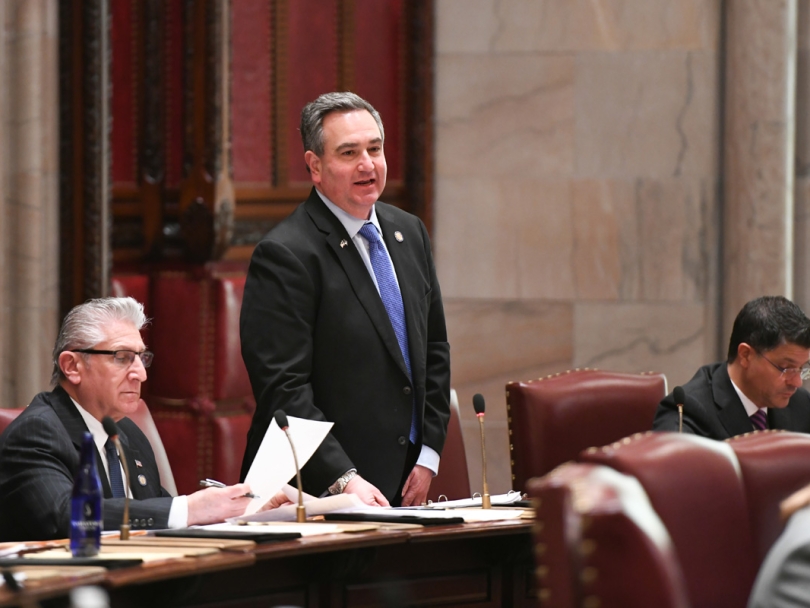
Relates to permitting an incarcerated individual who has had a final order of deportation issued against such incarcerated individual, has not been convicted of an A-1 felony and who is eligible for early release to receive a conditional release.
Directs the department of social services to establish a refugee resettlement program with the goals of achieving economic and social self-sufficiency, assisting victims of human trafficking, and assuring proper foster care for unaccompanied refugees.
This bill, the "racial and ethnic equity act" (A 6352), requires New York State to create racial and ethnic impact statements for certain bills that may affect correctional, public assistance, or child welfare systems. Before such bills can be considered by a committee, designated state agencies (like the Division of Criminal Justice Services for criminal justice bills) must prepare statements analyzing how a bill could change the racial and ethnic makeup of these populations using data and statistics. The statements must show whether a bill would disproportionately impact minority groups and cover at least three years of projected effects. This applies to bills that could increase incarceration, change penalties, alter public assistance access, or affect child welfare systems.
Requires the city university of New York and state university of New York have education programs for prospective teachers, administrators, and counselors for teaching immigrant-origin students that promotes diversity, equity and inclusion, and is multilingual.
Directs the department of health to contract with community-based organizations and not-for-profit corporations for the provision of outreach, information and educational services to immigrants on the availability of health care services, medical assistance, emergency medical assistance, the family health plus program and the child health insurance plan.
This bill amends election law to expand the definition of "language minorities" to include people of Middle Eastern or North African heritage (as defined by federal standards) and speakers of Haitian Creole. It directly affects election accessibility for these groups by adding them to the existing list of recognized language-minority groups under the law. The key mechanism is a simple definitional update to Section 17-204, ensuring these communities qualify for language assistance services during elections. The change applies to all election-related materials and support currently provided for other recognized language minorities. The bill takes effect one year after enactment.
This bill creates a $1,500 tax credit for small businesses (with 50 or fewer employees) that hire and retain eligible immigrant workers in full-time positions for at least six months. The credit directly benefits qualifying small businesses by reducing their tax liability and supports immigrant workers seeking stable employment. Businesses claim the credit per eligible worker hired and maintained for the required six-month period. The policy change applies only to small businesses meeting the employee threshold.
This bill requires all public universities and community colleges in the state to create a formal appeals process for students denied the in-state tuition rate. It directly affects students who receive a written denial of resident tuition status, regardless of their immigration status. The law mandates institutions establish clear time limits for filing appeals and responding to them, and requires posting detailed appeal information on their websites. The key change is creating a standardized, accessible process for students to challenge tuition classification decisions, without altering the existing eligibility criteria for resident status.
Requires continuing teacher and leader education to include courses, programs and activities related to immigrant focused trauma-informed practices to support students who are dealing with adverse childhood or adolescent experiences as a result of immigration status.
S 23 expands an existing tax credit for farmers to include the cost of constructing housing for farm workers. This change directly affects farmers who build residential housing for their employees, allowing them to claim the credit for construction materials and labor. The bill amends tax law to explicitly add "construction of residential housing occupied by farm workers" to the list of eligible expenses under the credit, which previously covered farm-related equipment and property. Farmers must still meet other requirements, such as property situs in the state and use in farming operations.