Issue · Environment

Environment (Wildlife)

Every environment bill, vote, and legislator stance in New York, automatically classified by Maddy, our AI policy reader.

Total bills
42
2025 Regular Session
Top supporter
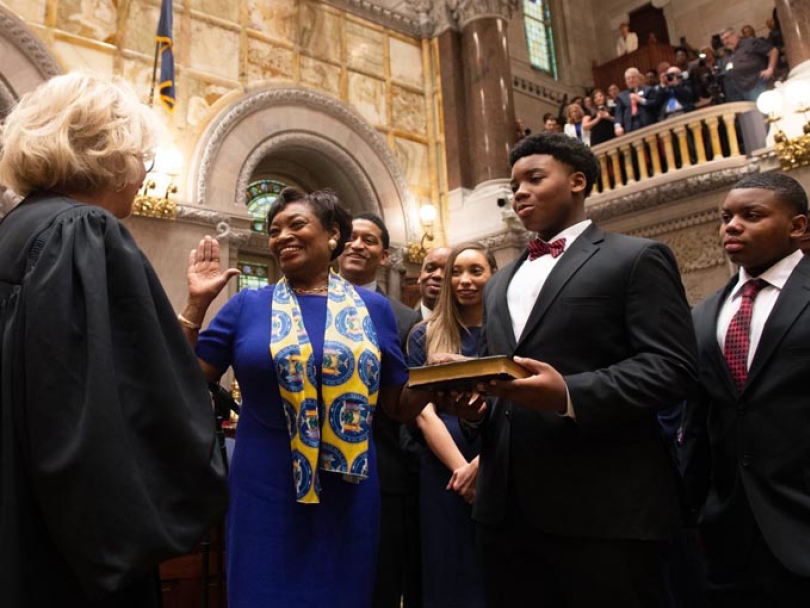
Andrea Stewart-Cousins
100% support rate
Top opponent
Rob Ortt
0% support rate
Ranked legislators
9
5 support · 4 oppose
Key legislators

Who's moving wildlife in New York

Legislators moving wildlife in New York
Legislator Party Stance Support rate Votes
Andrea Stewart-Cousins
Andrea Stewart-Cousins Senate · District 35
D
Strong +
100% 5
Jamaal Bailey
Jamaal Bailey Senate · District 36
D
Strong +
100% 5
Joe Addabbo
Joe Addabbo Senate · District 15
D
Strong +
100% 5
John Liu
John Liu Senate · District 16
D
Strong +
100% 5
Leroy Comrie
Leroy Comrie Senate · District 14
D
Strong +
100% 5
Rob Ortt
Rob Ortt Senate · District 62
R
Strong −
0% 5
Tom O'Mara
Tom O'Mara Senate · District 58
R
Strong −
0% 5
George Borrello
George Borrello Senate · District 57
R
Strong −
0% 3
Mark Walczyk
Mark Walczyk Senate · District 49
R
Strong −
0% 3
Showing 31–40 of 42 bills

All environment bills

in committee · New York · Senate Jan 7, 2026

S 5039: Changes the definition of the word "weed"

This bill changes the legal definition of "weed" in environmental law to specifically include plants designated as invasive, harmful, or poisonous under state or federal rules. It explicitly excludes endangered species and any plants native to the state from this definition. The change directly affects environmental agencies and land managers who enforce plant control regulations, providing clearer criteria for identifying regulated plants. This is a procedural adjustment to the law's language, not a new policy requiring funding or broad implementation.
Sub-Topics Wildlife
passed · New York · Senate Jan 28, 2025

J 261: Memorializing Governor Kathy Hochul to proclaim April 2025, as Native Plant Month in the State of New York

This resolution (S.261) asks Governor Hochul to officially designate April 2025 as "Native Plant Month" in New York State, aligning with National Native Plant Month. It recognizes the environmental importance of native plants - species naturally adapted to New York's ecosystems - which support local wildlife, improve soil and water health, and sustain biodiversity. The resolution does not create new laws or regulations but encourages public awareness and actions like planting native species and removing invasive plants. It directly affects New Yorkers by promoting community engagement with local environmental stewardship.
Sub-Topics Wildlife
in committee · New York · Assembly Feb 10, 2026

A 4615: Enacts the dark skies protection act

This bill requires most outdoor lighting fixtures (like those on buildings, streets, and parking lots) to be shielded by January 1, 2028, to reduce light pollution. It directly affects property owners, businesses, municipalities, and recreational facilities, which must turn off non-essential lighting between 11 p.m. and 5 a.m. Exemptions include airport navigation lights, emergency lighting, and certain historical or cultural sites. The law aims to protect dark skies for wildlife and stargazing, conserve energy, and reduce carbon emissions, with implementation beginning in 2028.
in committee · New York · Senate Jan 7, 2026

S 543: Establishes a forestry stewardship and habitat conservation credit for personal income and business franchise taxes

S 543 creates a tax credit for New York landowners who commit to forestry stewardship or habitat conservation on eligible land. Landowners with at least 25 contiguous acres certified as valuable wildlife habitat or suitable for recreation (e.g., fishing, hunting) can claim a credit equal to 25% of real property taxes paid on that land, up to $10,000 annually. To qualify, land must be part of a 5-year agreement with the state’s Department of Environmental Conservation, recorded publicly, and maintained under approved conservation plans. This credit directly affects private landowners managing conservation-eligible properties, reducing their personal income and business franchise tax burden.
in committee · New York · Assembly Jan 30, 2026

A 9115: Relates to a constitutional right to hunt, trap and fish

This bill proposes adding a constitutional right to hunt, trap, and fish to the state constitution. It states that these activities are part of the state's heritage and must be preserved, requiring state laws to manage wildlife while allowing traditional hunting, fishing, and trapping methods. The bill directly affects hunters, anglers, trappers, and state wildlife agencies, as it mandates that all management must balance preserving this heritage with conservation. Key provisions require state regulations to consistently protect both public access to these activities and wildlife populations, subject to reasonable state rules. The amendment must be referred to the next legislative session after the upcoming election for further consideration.
Sub-Topics Conservation Wildlife
passed · New York · Assembly Mar 4, 2025

K 159: Memorializing Governor Kathy Hochul to proclaim April 2025, as Native Plant Month in the State of New York

This bill is a symbolic resolution requesting Governor Hochul to declare April 2025 as "Native Plant Month" in New York State, aligning with National Native Plant Month. It does not create new laws or requirements but asks the Governor to formally recognize the ecological importance of native plants through a public proclamation. The resolution highlights how native plants support local wildlife, improve ecosystems, and are well-adapted to New York's environment. It directly affects the Governor's office and aims to encourage public awareness and actions like planting native species. (2 sentences, as it is a procedural resolution)
Sub-Topics Wildlife
in committee · New York · Assembly Jan 7, 2026

A 1109: Prohibits the hunting or taking of wildlife with the aid of an unmanned aerial vehicle

This bill (A 1109) prohibits hunting or taking wildlife using unmanned aerial vehicles (drones). It directly affects hunters who might use drones to locate or pursue animals, making such activity illegal under New York's environmental conservation law. The key provision bans the use of drones for hunting, defining "unmanned aerial vehicle" as any aircraft operated without direct human control from within the device. The law takes effect immediately upon enactment.
Sub-Topics Conservation Wildlife
in committee · New York · Senate Jan 7, 2026

S 1182: Prohibits the use of leg-gripping traps

S 1182 prohibits the use of leg-gripping traps (those with teeth in the jaws) for capturing wildlife in New York State, directly affecting trappers and wildlife management practices. The bill amends environmental conservation law to ban these traps except during specific beaver and otter trapping seasons in water, with strict size limits (jaws exceeding 5¾ inches on land, 7¼ inches in water). It also requires covered traps on land (using natural materials like soil or leaves) and mandates pan tensioning devices to reduce animal suffering. This law takes effect 30 days after enactment, replacing existing trap regulations.
Sub-Topics Conservation Wildlife
in committee · New York · Senate Jan 7, 2026

S 153: Relates to prohibiting the release of certain balloons

This bill prohibits releasing most balloons outdoors to reduce environmental harm from balloon debris, which pollutes waterways, harms wildlife through ingestion or entanglement, and damages industries like fishing. Exceptions include scientific experiments by government agencies, manned hot air balloons, and balloons released indoors. Violating the ban can result in fines up to $1,000 or up to 15 days in jail. The law applies to common balloons containing gas (like latex or mylar) released outside, excluding the specified exceptions.
Sub-Topics Recycling Wildlife
in committee · New York · Senate Feb 18, 2025

S 5007: Enacts the dark skies protection act

S 5007, the "Dark Skies Protection Act," requires all outdoor lighting fixtures (including those on homes, businesses, and public spaces) to be shielded by January 1, 2028, to reduce light pollution. The law aims to protect the night sky for wildlife, safety, and energy conservation while exempting essential uses like airport lighting, emergency services, and certain safety-focused fixtures. Municipalities may adopt stricter rules than the state law, and property owners face civil penalties for noncompliance (up to $1,000 for commercial properties after repeated violations). The bill directly affects all property owners and businesses using outdoor lighting across the state.
Showing 31 to 40 of 42 bills
Previous 1 3 4 5 Next