

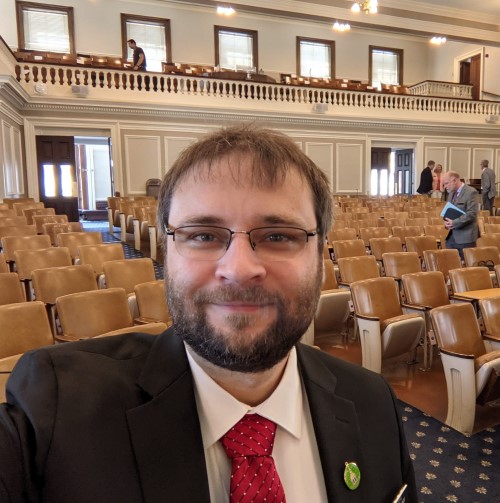
Photo of Lex Berezhny
R New Hampshire House · District Grafton 11

Rep. Lex Berezhny

Compare
Total votes
1,429
all sessions
Attendance
100%
6 missed
Near the chamber average
With party
93%
of cast votes
Near the chamber average
Bipartisan score
4%
crosses aisle rarely
Near the chamber average
Sponsored
46
bills & resolutions
Near the chamber average
Committees
1
assignment
46 bills and resolutions

Sponsored bills

Total
46
Primary
8
Co-sponsor
38
This page
46
matching current filters
Co-sponsor HB 1721
died · New Hampshire House · Co-sponsor
relative to limiting new system enrollment and adjusting compliance payments under the renewable portfolio standard program.

Maddy summaryHB 1721 limits new renewable energy system enrollment under New Hampshire's Renewable Portfolio Standard (RPS) program. It prohibits any new systems from joining after a six-month window following its effective date (July 1, 2026), restricting eligibility to systems operational before 2026. The bill caps renewable energy certificate (REC) eligibility at 20 years per system, with existing systems already over 15 years receiving up to five additional years of credits. It also requires the Department of Energy to annually reduce Alternative Compliance Payments (ACPs) as the number of eligible systems declines, directly affecting future RPS program funding.

died Aug 20, 2026 1 co-sponsor
Co-sponsor HB 1003
Signed into law · New Hampshire House · Co-sponsor
prohibiting the Grafton county attorney from engaging in the private practice of law.

Maddy summaryHB 1003 prohibits Grafton County Attorney from engaging in private legal practice for compensation, except when providing free legal services to family members without conflicts of interest. The bill adds a new section (7:34-h) to New Hampshire law, explicitly banning the county attorney from accepting fees for private legal work beyond their official salary. This directly affects the Grafton County Attorney position, requiring them to focus solely on public duties without outside legal engagements. The law takes effect immediately upon passage.

Signed into law Jun 9, 2026 1 co-sponsor
Co-sponsor HB 1134
Passed · New Hampshire House · Co-sponsor
relative to the town meeting form of local governance.

Maddy summaryHB 1134 clarifies how town meeting budget items are counted for tax and budget cap calculations. It requires that total appropriations in warrant articles (budget items) be accumulated in the order they are voted on during annual town meetings, rather than by their position on the agenda. This directly affects towns operating under the town meeting form of government, ensuring consistent application when determining if a budget exceeds the 10% expenditure limit or triggers a tax cap override. The bill makes this procedural change to prevent ambiguity in budget voting outcomes.

Passed Apr 3, 2026 1 co-sponsor
Co-sponsor HB 1475
Failed · New Hampshire House · Co-sponsor
directing the department of energy to study the portion of electric distribution costs attributable to fixed versus usage-based charges.

Maddy summaryHB 1475 requires New Hampshire's Department of Energy to study how electricity distribution costs are split between fixed fees (charged to all customers regardless of usage) and usage-based fees (based on kilowatt-hour consumption). The study must examine specific cost categories like storm recovery, infrastructure replacement (e.g., poles), and capacity upgrades tied to demand. The Department must report findings and recommendations to the legislature and governor by November 2026, with costs recovered through existing utility assessments that would have minimal impact on individual customer bills.

Failed Feb 19, 2026 1 co-sponsor
Co-sponsor CACR 6
died · New Hampshire House · Co-sponsor
relating to the right to compute. Providing that the right of individuals to use computation resources shall not be infringed.

Maddy summaryCACR 6 is a concurrent resolution (not a binding law) that states individuals have a right to use computation resources without infringement. It makes a broad, non-enforceable declaration about computational access but includes no specific mechanisms, regulations, or affected groups. The resolution was referred to committee, where it was deemed "Inexpedient to Legislate" by a 17-0 vote on November 12, 2025, and did not advance further. As a procedural resolution, it does not create new policies or directly affect any individuals or entities.

died Nov 19, 2025 1 co-sponsor
Primary HB 723
Passed · New Hampshire House · Lead sponsor
repealing the multi-use energy data platform.

Maddy summaryHB 723 would repeal the existing "multi-use energy data platform," removing a state-run system that collected and shared energy usage information. This bill directly affects the state agency or utility providers currently operating the platform, as it would eliminate their requirement to use this specific system. The key mechanism is the repeal of the underlying law establishing the platform, effectively ending its operation without creating a replacement system. (Note: As a procedural repeal bill, this summary is concise and focuses solely on the policy change described in the bill's title.)

Passed Nov 4, 2025 0 co-sponsors
Co-sponsor HB 200
Signed into law · New Hampshire House · Co-sponsor
relative to the procedure for overriding a local tax cap.

Maddy summaryHB 200 creates a new process for local governments to exceed their legally established tax caps. It directly affects cities and towns that hit their tax limits, allowing them to raise taxes above those caps through a specific procedure. The key mechanism requires a two-thirds vote by a local governing body (like a city council) to request an override from the state, followed by a state review. This law, signed by Governor Ayotte and effective September 13, 2025, replaces previous ad-hoc approaches with a standardized state-level review process.

Signed into law Jul 22, 2025 1 co-sponsor
Primary HB 151
Signed into law · New Hampshire House · Lead sponsor
relative to the term for supervisors of the checklist.

Maddy summaryHB 151, titled "relative to the term for supervisors of the checklist," appears to be a procedural bill adjusting term lengths for a specific administrative position. The bill was enacted after passing through legislative chambers and receiving the Governor's signature on July 7, 2025, with an effective date of September 13, 2025. The provided context does not specify the exact role of "supervisors of the checklist" or the nature of the term changes, so no concrete policy details can be summarized. As a procedural measure, this bill focuses on administrative structure rather than substantive policy.

Signed into law Jul 22, 2025 0 co-sponsors
Co-sponsor HB 504
Signed into law · New Hampshire House · Co-sponsor
relative to the state energy policy.

Maddy summaryHB 504 establishes New Hampshire's official state energy policy, directly affecting utilities, energy providers, and all state residents by setting new guidelines for energy planning. The bill declares that the state must prioritize meeting energy needs at the lowest reasonable cost while ensuring reliability, diversity of sources, environmental protection, and public health - using market mechanisms rather than government favoritism toward specific technologies. Key provisions include requiring utilities to develop resources that support energy independence, removing regulatory barriers for innovation, and balancing cost, reliability, and environmental goals through market-based approaches. It also mandates that state regulations avoid unnecessary costs while protecting consumer prices and utility financial stability.

Signed into law Jul 22, 2025 1 co-sponsor
Co-sponsor HB 710
Signed into law · New Hampshire House · Co-sponsor
enabling electric utilities to own, operate, and offer advanced nuclear resources, and relative to purchased power agreements for electric distribution utilities and limitations on community customer generators.

Maddy summaryHB 710 allows electric utilities to own, operate, and offer new advanced nuclear power plants, expanding their energy generation options. It modifies rules for utilities purchasing power from other providers and adds restrictions on community solar and small-scale generator programs. The bill directly affects utilities, power providers, and customers participating in community energy projects. Key provisions include enabling nuclear ownership, adjusting power purchase agreements, and limiting community generator capacity. This is a substantive policy change focused on energy infrastructure and market rules.

Signed into law Jul 8, 2025 1 co-sponsor
Showing 1 to 10 of 46 bills
1 2 3 … 5 Next