

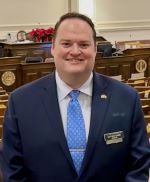
Photo of Matt Coker
R New Hampshire House · District Belknap 2

Rep. Matt Coker

Compare
Total votes
1,038
all sessions
Attendance
84%
168 missed
Lower than 85% of chamber peers
With party
63%
of cast votes
Lower than 100% of chamber peers
Bipartisan score
18%
some cross-party votes
Higher than 99% of chamber peers
Sponsored
51
bills & resolutions
Near the chamber average
Committees
1
assignment
51 bills and resolutions

Sponsored bills

Total
51
Primary
7
Co-sponsor
44
This page
51
matching current filters
Co-sponsor HB 1193
Signed into law · New Hampshire House · Co-sponsor
naming a 911 call service center in Laconia in honor of Bruce G. Cheney.

Maddy summaryThis bill (HB 1193) names the new 911 call service center in Laconia, New Hampshire (located at 311 Meredith Center Road) the "Bruce Cheney 911 Service Center" in recognition of Bruce G. Cheney's role in developing New Hampshire's statewide 911 emergency call system. It does not change any laws or policies - it is a commemorative act honoring Cheney's contributions. The naming takes effect 60 days after the bill is passed. This bill directly affects the facility's official designation and serves as a tribute to Cheney.

Signed into law Jul 10, 2026 1 co-sponsor
Co-sponsor HB 1594
Signed into law · New Hampshire House · Co-sponsor
establishing a weight-based tiered registration fee schedule for electric and plug-in hybrid vehicles.

Maddy summaryHB 1594 changes New Hampshire's registration fees for electric vehicles from a flat rate to a weight-based system. Fully electric cars (BEVs) will pay $25 for vehicles under 2,000 pounds, $100 for 2,000-5,000 pounds, and $150 for heavier models, while plug-in hybrid vehicles (PHEVs) will continue to pay $50 regardless of weight. Neighborhood electric vehicles and low-speed scooters would be exempt from fees. The fees collected would go into the highway fund, and the bill takes effect July 1, 2026.

Signed into law Jul 10, 2026 1 co-sponsor
Co-sponsor HB 1466
Signed into law · New Hampshire House · Co-sponsor
relative to obtaining a certificate of title for certain trailers.

Maddy summaryHB 1466 exempts trailers over 3,001 pounds with a manufacturer's model year more than 10 years old from needing a certificate of title. This directly affects owners of these older, heavier trailers, who would no longer need to pay title fees or complete the title application process for qualifying vehicles. The bill amends state law to add this age-based exemption, which currently requires titles for all trailers over 3,001 pounds regardless of age. As a result, it removes a regulatory requirement for trailers meeting both the weight and age criteria.

Signed into law Jun 24, 2026 1 co-sponsor
Co-sponsor HB 1768
Passed · New Hampshire House · Co-sponsor
relative to gifts and donations received by the division of parks and recreation.

Maddy summaryHB 1768 provides free day-use admission and metered parking at New Hampshire state parks for honorably discharged veterans who are state residents. It exempts eligible veterans from these fees upon presenting proof like a veteran license plate, DD-214 form, or other recognized documentation. The bill directly affects New Hampshire veterans meeting these criteria, removing financial barriers to park access. The fiscal note estimates an annual revenue loss of $200,000-$450,000 for the State Park Fund, based on park fee data and veteran residency assumptions.

Passed May 21, 2026 1 co-sponsor
Primary HB 1330
Failed · New Hampshire House · Lead sponsor
allowing all registered voters to vote in state and presidential primaries regardless of declared party affiliation.

Maddy summaryHB 1330 would change New Hampshire's primary voting rules to allow any registered voter to participate in the primary election of any political party, regardless of their own party affiliation or if they have no declared party. This affects all registered voters in the state who wish to vote in either state or presidential primaries. The key provision removes the current requirement that voters must declare a party to vote in that party's primary, instead permitting voters to choose any party's primary ballot. Voters would still be restricted to casting only one primary ballot per election. The bill would take effect 60 days after enactment.

Failed Mar 11, 2026 0 co-sponsors
Co-sponsor HB 1070
Failed · New Hampshire House · Co-sponsor
relative to the involuntary emergency admission process.

Maddy summaryHB 1070 mandates that individuals placed in protective custody for suspected mental health crises must be transported by ambulance to a hospital or designated mental health site for evaluation, rather than by law enforcement. This applies directly to people experiencing acute mental health emergencies who are deemed a danger to themselves or others. The bill requires emergency medical technicians to provide care during transport, sets a 6-hour limit for protective custody, and allows law enforcement to override ambulance transport only if the individual poses a safety risk to medical personnel. It does not change eligibility criteria for involuntary admission but standardizes the initial transport process for mental health evaluations.

Failed Mar 11, 2026 1 co-sponsor
Co-sponsor HB 1391
died · New Hampshire House · Co-sponsor
establishing a commission to study the implementation of a single ballot primary election.

Maddy summaryHB 1391 establishes a 9-member commission to study implementing a single ballot primary election in New Hampshire. The commission includes balanced legislative representation (two House members, one from each major party; two Senate members, one from each party), the Secretary of State, and representatives from non-partisan civic groups, local election officials, and municipal associations. The commission will research the feasibility of this system and submit recommendations to state leaders by November 1, 2027. This bill creates a study process only - it does not change current election rules or mandate any specific voting system.

died Mar 4, 2026 1 co-sponsor
Primary HB 1627
Failed · New Hampshire House · Lead sponsor
creating a single primary ballot.

Maddy summaryHB 1627 creates a single primary ballot for all state and congressional candidates in New Hampshire, replacing the previous system where voters could only choose from candidates of their registered party. This change allows any registered voter to vote for any candidate in the primary, regardless of their own party affiliation or lack of registration. The bill clarifies that candidates may indicate a party preference on the ballot, but this does not imply party endorsement or make them the official candidate of that party. It also modifies sample ballot distribution and vote-counting rules for primaries, requiring votes for the same candidate across different party ballots to be counted separately. This directly affects all registered voters participating in New Hampshire's state and congressional primaries.

Failed Feb 19, 2026 0 co-sponsors
Co-sponsor HB 1580
Failed · New Hampshire House · Co-sponsor
relative to the taxation of non-primary residences.

Maddy summaryHB 1580 imposes a 0.75% annual surcharge on the assessed value of residential properties not used as the owner’s primary residence (defined as living there 183+ days yearly and listing it for voter/driver’s license/tax purposes). It directly affects owners of second homes, vacation properties, or vacant residential properties (including single-family homes, condos, and mobile homes). Key exemptions include primary residences, long-term rentals (6+ months), properties under $500,000, and those qualifying for existing tax exemptions. Revenue collected must be used by municipalities to reduce property taxes or fund local services like schools and infrastructure. The bill takes effect April 1, 2027.

Failed Feb 12, 2026 1 co-sponsor
Co-sponsor HB 1509
Failed · New Hampshire House · Co-sponsor
relative to judicial immunity and permitting civil actions against judicial officers for certain criminal bail decisions.

Maddy summaryHB 1509 would remove judicial immunity for judges who make bail decisions under specific circumstances. It allows civil lawsuits against judges if they release a defendant for certain offenses (like violations of RSA 631:2-b, felonies, or crimes committed while on prior bail), the released defendant then commits a new crime or intentional tort, and another person suffers physical or financial injury as a result. Injured parties or their estates could sue, and courts would not apply judicial immunity in these cases. The bill takes effect January 1, 2027, and does not change bail standards but creates a new legal pathway for accountability.

Failed Feb 12, 2026 1 co-sponsor
Showing 1 to 10 of 51 bills
1 2 3 6 Next