Issue · Labor & Employment

Labor & Employment

Every labor & employment bill, vote, and legislator stance in Montana, automatically classified by Maddy, our AI policy reader.

Total bills
147
2025 Regular Session
Top supporter
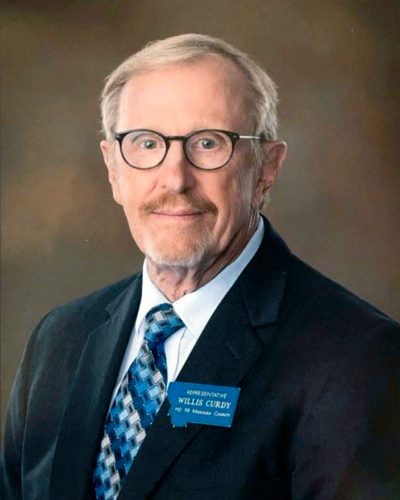
Willis Curdy
92% support rate
Top opponent
Caleb Hinkle
13% support rate
Ranked legislators
10
5 support · 5 oppose
Key legislators

Who's moving labor & employment in Montana

Legislators moving labor & employment in Montana
Legislator Party Stance Support rate Votes
Willis Curdy
Willis Curdy Senate · District 49
D
Strong +
92% 290
Pat Flowers
Pat Flowers Senate · District 31
D
Strong +
92% 288
Sara Novak
Sara Novak Senate · District 36
D
Strong +
92% 291
Dave Fern
Dave Fern Senate · District 2
D
Strong +
92% 285
Gayle Lammers
Gayle Lammers Senate · District 21
R
Strong +
91% 291
Caleb Hinkle
Caleb Hinkle House · District 68
R
Strong −
13% 261
Tom Millett
Tom Millett House · District 2
R
Strong −
17% 258
Kathy Love
Kathy Love House · District 85
R
Strong −
19% 251
Carl Glimm
Carl Glimm Senate · District 3
R
Oppose
21% 307
Jedediah Hinkle
Jedediah Hinkle House · District 67
R
Oppose
22% 255
Showing 131–140 of 147 bills

All labor & employment bills

died · Montana · Legislature May 27, 2025

LC 3262: Establishing a portable benefits plan

This bill (LC 3262) titled "Establishing a portable benefits plan" was introduced but never advanced beyond the drafting stage. It was assigned a drafter in December 2024, moved through several holds, and ultimately "died in process" on May 27, 2025. The provided context does not include the bill's specific provisions, target beneficiaries, or mechanisms, so no substantive summary can be generated. The bill's title suggests it aimed to create a system for workers to carry benefits between jobs, but no details on how this would function are available.
died · Montana · Legislature May 27, 2025

LC 2769: Revise laws for receipt of workers' compensation benefits on behalf of others

Bill LC 2769, titled "Revise laws for receipt of workers' compensation benefits on behalf of others," aimed to update procedures allowing representatives (such as family members or legal guardians) to receive workers' compensation benefits for injured workers. The bill sought to clarify who could legally act on behalf of an injured worker and streamline the process for benefit distribution. However, the bill did not advance beyond the drafting stage and was officially "dead" as of May 27, 2025. Without further details on its specific provisions, the exact policy changes remain unspecified. This bill would have directly affected injured workers and their designated representatives in the workers' compensation system.
died · Montana · Senate May 23, 2025

SB 308: Revising workers' compensation insurance laws to remove the limitation on benefits to the state's weekly average wage

SB 308 would remove Montana's current limit on workers' compensation benefits that capped payments at the state's average weekly wage. Instead, it would establish a fixed maximum benefit of $2,885 per week for all eligible injured workers. This change would directly affect higher-earning workers who previously received reduced benefits due to the wage-based cap. The bill amends specific sections of Montana's workers' compensation code to implement this fixed maximum payment structure.
died · Montana · House May 20, 2025

HB 812: Generally revise unemployment laws relating to non-professional employees of educational institutions

HB 812 aimed to revise state unemployment laws specifically concerning nonprofessional employees of educational institutions. Currently, employees in educational settings are generally denied unemployment benefits between academic terms if they have a reasonable assurance of returning to work. This bill proposed to allow nonprofessional employees of educational institutions to claim unemployment benefits during these interim periods, in alignment with federal law. The change would have enabled these specific workers to receive unemployment compensation during breaks when they might otherwise be ineligible.
Sub-Topics Unemployment
signed · Montana · House May 5, 2025

HB 336: Provide for apprenticeship programs for certain license types

HB 336 establishes an alternative pathway for individuals to obtain professional licenses in various occupations through apprenticeship programs. It requires state boards and programs to grant licenses to applicants who successfully complete a nationally recognized apprenticeship in their field. This applies to a wide range of professions, including barbers, cosmetologists, addiction counselors, licensed practical nurses, plumbers, and electricians. Applicants pursuing licensure via an apprenticeship must still meet the same examination and fee requirements as those who complete traditional educational programs.
died · Montana · Senate May 23, 2025

SB 515: Enacting the cosmetology licensure compact

SB 515 would create a multistate cosmetology licensure compact, allowing licensed cosmetologists to practice in participating states using a single license instead of obtaining separate licenses in each state. It requires criminal background checks for all applicants and establishes uniform standards for licensure, including shared disciplinary records between states to maintain safety. The bill specifically aims to reduce licensing barriers for cosmetologists relocating due to military service or family moves. This program would replace individual state licenses with a single multistate license valid across all compact member states.
Sub-Topics Professional Licensing Tags Licensing
signed · Montana · House May 5, 2025

HB 656: Revising the fund structure and use of employment security account

HB 656 revises the use of the state's Employment Security Account and transfers the Office of Community Service. The bill amends state law to allow funds from the Employment Security Account to be used for administering the Office of Community Service and for enforcing state and federal anti-discrimination laws. Additionally, it moves the Office of Community Service from the Governor's office to the Department of Labor and Industry.
died · Montana · House May 20, 2025

HB 297: Establish requirement for paid sick days

HB 297, known as the "Healthy Families and Workplaces Act," aimed to establish a requirement for paid sick leave for employees. It would have required employers with 10 or more employees to provide at least one hour of paid sick leave for every 40 hours worked, with an annual usage cap of 80 hours. Employees could carry over up to 40 unused hours to the following year. The bill also defined authorized uses for paid sick leave, protected employees from retaliation, and authorized the Department of Labor and Industry to enforce its provisions. Employers with existing paid leave policies that met or exceeded these requirements would have been exempt.
signed · Montana · House May 13, 2025

HB 823: Revise laws relating to the state plan committee

HB 823 revises the State Plan Committee, which oversees career and technical education in Montana. It expands the committee by adding three new members appointed by the Commissioner of Labor and Industry, representing the state workforce innovation board, business, and labor communities. The bill also coordinates the committee's meetings with the Montana State Workforce Innovation Board and requires its state plan to align with the federal Workforce Innovation and Opportunity Act combined state plan.
Sub-Topics Public Employees
died · Montana · Senate May 23, 2025

SB 291: Revising laws related to workers' compensation definition of wages

SB 291 amends Montana's workers' compensation law to require the Department of Labor and Industry to annually update its rules defining the value of lodging provided to employees as part of their compensation. The bill specifically changes Section 39-71-123 to mandate that lodging values must be adjusted yearly based on geographic housing costs and other reasonable factors. This affects workers in occupations where housing is part of their wages, such as agricultural or hospitality roles, ensuring the value used for calculating workers' compensation benefits reflects current local housing markets. The change focuses on the administrative process for valuing lodging, not on altering who qualifies for workers' compensation coverage.
Showing 131 to 140 of 147 bills