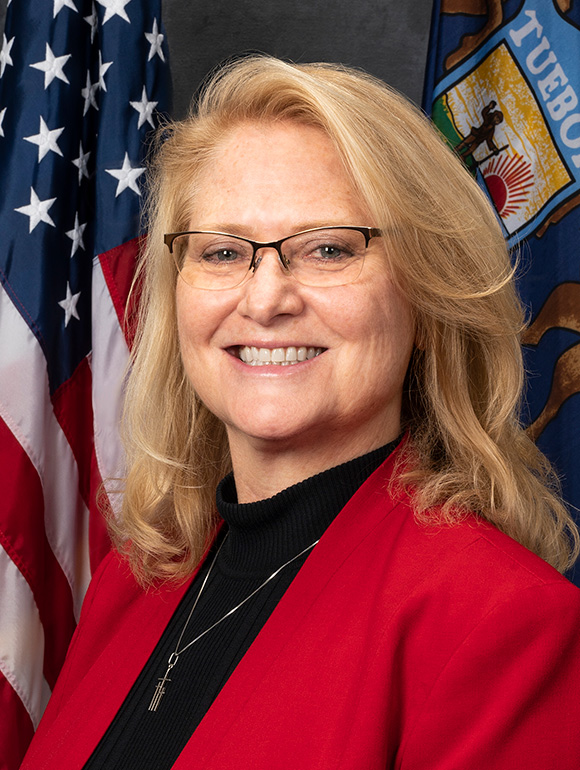
HB 4572 is an appropriations bill that allocates funding for Michigan's Department of Military and Veterans Affairs for the fiscal year ending September 30, 2026. It establishes the specific budget amount the department can spend on military and veterans programs during this period. The bill directly affects the department's operations and the veterans and military personnel it serves through its funded services. As a routine budget measure, it creates the legal framework for spending but does not change existing programs or policies.
HB 5308 requires Michigan watercraft owners to purchase an annual $35 "Great Lakes protection" decal. Revenue from these decals funds invasive species prevention and remediation efforts under Section 80124b. The bill mandates that the state agency discontinue sales if fewer than 2,000 decals are sold by September 2006, then fewer than 500 annually after that. It directly affects recreational boat owners in Michigan who must buy the decal to legally operate watercraft. The decal design is specified but placement rules allow flexibility for law enforcement.
This bill modifies Michigan's sales tax rules for online marketplace facilitators, requiring them to collect and remit sales tax on all taxable sales made through their platforms regardless of whether the individual sellers have a physical presence in the state. It establishes that marketplace facilitators are responsible for auditing only their own facilitated sales unless sellers fail to provide necessary information, while also protecting facilitators from liability when sellers provide incorrect data or pay the tax directly. The legislation creates a special provision for delivery network companies, allowing them to deduct or exclude from their tax liability the sales tax they paid to marketplace sellers for qualified delivery services, such as those performed by couriers using personal vehicles or walking for distances under 75 miles.
SB 581 updates definitions in Michigan's downtown development law to clarify how tax increment financing (TIF) programs operate. It specifically revises the definition of "downtown district" to allow multiple geographic areas within a business district under certain conditions (like inter-municipal agreements), defines "captured assessed value" for TIF calculations, and limits "catalyst development projects" to one per authority (requiring $300 million+ investment in cities over 600,000 population). These changes directly affect municipalities operating downtown development authorities that use TIF to fund redevelopment. The bill focuses on precise terminology to ensure consistent application of existing TIF rules, without creating new funding mechanisms.
HB 5517 creates a $0.005 per returnable beverage container tax credit for distributors who charge a deposit on containers, effective for tax years beginning January 1, 2026. The credit adjusts annually based on the U.S. Consumer Price Index starting in 2027. Distributors must attach a specific report (per 1976 IL 1) with their tax return to claim the credit, and any excess credit is refunded. This directly affects beverage distributors handling returnable containers in Michigan.
HB 4080 reinstates a program deferring property tax special assessments for eligible Michigan homestead owners. It applies to assessments due before October 1, 2020, or on/before October 1, 2022, for primary residences owned by qualifying individuals (including those who are totally and permanently disabled). The bill allows owners to defer payments until death, sale, or transfer of the property, with up to four annual partial payments (minimum $500 or 5% of the balance) and interest accruing on unpaid amounts. Full payment becomes due upon sale, transfer, or death, and the bill requires the state to notify owners of these terms. This amendment to Michigan’s 1976 property tax law (MCL 211.761-762) is contingent on HB 4079 passing.
HB 4079 adjusts the income limit for homeowners aged 65 or older, or those totally and permanently disabled, who qualify for a property tax deferment on special assessments. Currently set at $34,900 as of October 2022, the bill replaces this fixed amount with an annual adjustment based on the Detroit-area Consumer Price Index (CPI), meaning the limit will rise or fall each year with local inflation. The state treasurer will calculate the new limit annually using the prior year's CPI data, rounding to the nearest dollar. This change directly affects eligible homeowners seeking to defer special assessments on their primary residences without immediate payment.
HB 4576 is the fiscal year 2025-2026 appropriations bill for the Michigan Department of Education. It authorizes specific funding levels for the department's operations and programs during the upcoming state fiscal year. The bill passed the House on June 11, 2025, with 56 ayes, 53 noes, and 1 excused. As a procedural appropriations act, it establishes the legal funding framework but does not detail specific programs or spending items beyond the authorized amounts.
HB 4420 creates a standardized form requiring Michigan legislators to disclose any spending items they direct to specific projects or organizations. This requirement applies directly to all state legislators and state agencies when allocating funds based on legislative direction. The key mechanism mandates that this disclosure form be completed for every instance of directed spending, ensuring consistent public transparency. The bill aims to clarify and document how lawmakers influence state fund allocation without altering the underlying spending authority.
SB 596 creates a formal process for state agencies to request and monitor legislatively directed spending items within the state budget. It requires agencies to submit such requests through a defined procedure and track how funds are used, affecting state departments and legislators who direct funding. The bill amends Michigan's state finance law (MCL 18.1101-18.1594) to establish this requirement. The bill was approved by the governor and became law on November 18, 2025.