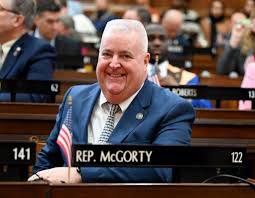
Key legislators
Who's moving education in Connecticut
Showing 11–13 of 13
bills
All education bills
SB 298 reallocates state funds across multiple agencies for the 2025-2026 fiscal year. It reduces $3.4 million from Temporary Family Assistance (TANF) funding for the Department of Social Services while appropriating $1.7 million to the Labor Department for unemployment program IT upgrades and $1.7 million to the Department of Education for Adult Education. The bill allocates $1.5 million to five school districts (Newington, Wethersfield, Cromwell, Rocky Hill, Middletown) for high-acuity school-based mental health programs and $750,000 for a teacher residency program operated by the Capitol Region Education Council. These changes directly affect TANF recipients, school districts, mental health providers, and teacher training initiatives.
HB 5426 requires all state institutions of higher education to allow students to bring an advisor or support person of their choice to disciplinary meetings starting July 1, 2026. This directly affects students facing disciplinary actions at public colleges and universities, ensuring they can have support during these proceedings. The policy must be adopted by August 1, 2026, with two key conditions: the advisor cannot delay the meeting, and for sexual assault, stalking, or intimate partner violence cases, existing state policies (Section 10a-55m) override this rule if they differ. The bill does not change disciplinary outcomes but mandates institutional policy changes to provide student support.
This bill proposes the approval of a collective bargaining agreement between the University of Connecticut Board of Trustees and the Graduate Employee Union, which represents graduate student employees at the university. The agreement covers a four-year period from July 1, 2026, to June 30, 2030, and includes provisions for wage increases, adjustments to health insurance premiums, and changes to university fee credits. By ratifying this contract, the Connecticut General Assembly formally authorizes the university to implement these terms, which are expected to result in net costs to the university's operating fund totaling approximately $29.6 million over the agreement's duration.