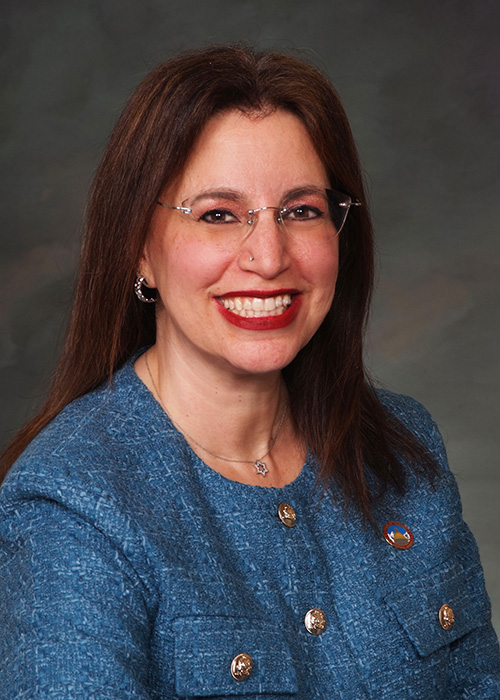
Photo of Dafna Michaelson Jenet
D Colorado House · District 32

Rep. Dafna Michaelson Jenet

Compare
Total votes
5,680
all sessions
Attendance
92%
448 missed
Lower than 97% of chamber peers
With party
99%
of cast votes
Higher than 98% of chamber peers
Bipartisan score
1%
crosses aisle rarely
Lower than 95% of chamber peers
Sponsored
121
bills & resolutions
Lower than 100% of chamber peers
Committees
0
assignments
121 bills and resolutions

Sponsored bills

Total
121
Primary
121
Co-sponsor
0
This page
121
matching current filters
Primary HB 22-1274
Signed into law · Colorado House · Lead sponsor
Sunset Colorado Interagency Working Group On School Safety

The Colorado interagency working group on school safety (working group) is scheduled to repeal on September 1, 2022. The act continues the working group indefinitely and requires the department of public safety to convene the first meeting of the working group no later than December 31, 2022. The act appropriates $100,000 from the general fund to the department of public safety for the working group. (Note: This summary applies to this bill as enacted.)

Signed into law Jun 8, 2022 0 co-sponsors
Primary HB 22-1354
Signed into law · Colorado House · Lead sponsor
Protecting Injured Workers' Mental Health Records

The act clarifies provisions in the "Workers' Compensation Act of Colorado" (workers' compensation act) relating to the release and disclosure of mental health records pertaining to an injured employee making a claim under the workers' compensation act (claimant). The act: Defines "mental health records" psychological or psychiatric tests, including neuropsychological testing; other records prepared by or for a mental health provider; independent medical examination records, audio recordings, and reports that address psychological or psychiatric issues; division independent medical evaluation records and reports that address psychological or psychiatric issues; and records relating to the evaluation, diagnosis, or treatment of a substance use or abuse disorder; Requires a mental health provider to provide an insurer or employer, if self-insured, with mental health records, as necessary for payment, adjustment, and adjudication of claims involving psychological or psychiatric issues; to the employer, as necessary, to enable to employer to comply with applicable state and federal laws, rules, and regulations; and to the referring physician and any other relevant treating or evaluating providers; Prohibits the disclosure of mental health records to any person who is not reasonably necessary for the medical evaluation, adjustment, or adjudication of claims involving psychological or psychiatric issues, unless otherwise directed by order of the director of the division of workers' compensation (director) or an administrative law judge; Permits an insurer to release information from a claimant's mental health records to the claimant's employer concerning work restrictions and information necessary for the adjustment or adjudication of the claim, but prohibits the disclosure of the claimant's actual mental health records to third parties that do not need the information; and For a self-insured employer: Requires the employer to keep a claimant's mental health records separate from personnel files; Limits disclosure of the claimant's mental health records to a supervisor or manager to only information from the mental health records pertaining to work restrictions placed on the claimant; and Prohibits disclosure of the claimant's mental health records to any third party and redisclosure by the third party to any person who is not directly involved in adjusting or adjudicating claims involving psychological or psychiatric issues, unless the disclosure is otherwise ordered by the director or an administrative law judge. The act authorizes the director to promulgate rules necessary for the implementation of the act. The act requires a person providing mental health services under the workers' compensation act to be a licensed mental health provider. (Note: This summary applies to this bill as enacted.)

Signed into law Jun 8, 2022 0 co-sponsors
Primary HB 22-1375
Signed into law · Colorado House · Lead sponsor
Child Residential Treatment And Runaway Youth

The act creates the Timothy Montoya task force to prevent children from running away from out-of-home placement (task force) in the office of the child protection ombudsman. The task force must analyze data related to children who have run away from out-of-home placement; analyze the root causes of why children run away from out-of-home placement; identify and analyze behaviors that constitute running away from out-of-home placement; analyze the likelihood that children who have run away will become a victim of crime; analyze best practices, state laws and regulations, and placement facility protocols and practices related to children running away; develop a consistent, prompt, and effective response to recover missing children; and address the safety and well-being of a child who has run away upon the child's return to out-of-home placement. The office of the child protection ombudsman must enter into an agreement with an institution of higher education to perform research that supports the task force's work and conduct focus groups with children in out-of-home placement, young adults who have aged out of the child protection system, and out-of-home placement providers. The task force is required to issue a preliminary report by October 1, 2023, and a final report by October 1, 2024. Each report must include the task force's findings and recommendations to reduce the number of children who run away from out-of-home placement. The act appropriates $99,500 from the general fund to the judicial department for use by the office of the child protection ombudsman for program costs. (Note: This summary applies to this bill as enacted.)

Signed into law Jun 7, 2022 0 co-sponsors
Primary HB 22-1056
Signed into law · Colorado House · Lead sponsor
Emergency Temporary Care For Children

The act requires the general assembly to annually appropriate money to the state department of human services (state department) sufficient to fund 5 nights of care for each juvenile placed in a licensed temporary shelter. The state department allocates the money to judicial districts in accordance with a formula developed by the working group for criteria for placement of juvenile offenders (working group). In order to receive an allocation, a judicial district's juvenile services planning committee, or the judicial district if the judicial district has not established a juvenile services planning committee, must include a plan for providing temporary shelter in the judicial district in its local juvenile services plan. Under existing law, the working group is required to make recommendations regarding the placement of juveniles. The act requires the house of representatives public and behavioral health and human services committee and the senate health and human services committee to annually hold a joint meeting to determine whether the working group's recommendations have been implemented in a manner that warrants discontinuing the annual appropriation for 5 nights of care in a licensed temporary shelter and the requirement that judicial districts develop a plan for providing temporary shelter. The act defines temporary shelter as the temporary care of a child in a physically unrestricted setting pending a return to the child's home or placement in an appropriate alternate setting pursuant to applicable state law. Temporary care in a temporary shelter is voluntary and a child may not be placed in a licensed temporary shelter facility for more than 5 days. The act requires a person providing temporary shelter to allow professionals to assess children there, and a child in temporary shelter must have access to educational services. The act appropriates $137,308 to the state department from the general fund for use by the division of youth services to implement the act. (Note: This summary applies to this bill as enacted.)

Signed into law Jun 7, 2022 0 co-sponsors
Primary HB 22-1077
Signed into law · Colorado House · Lead sponsor
Colorado Nonprofit Security Grant Program

The act creates the Colorado nonprofit security grant program to provide money to qualified nonprofit organizations that are at high risk of a terrorist attack and that applied for, but did not receive, a grant from the federal nonprofit security grant program. Grant recipients may use the money for the following security-related activities: The installation of security equipment on real property owned or leased by the nonprofit organization; Security-related planning, exercises, training, and contracted security personnel; New or existing infrastructure; except that priority must be given to existing infrastructure projects; or Any other approved security enhancements. The act appropriates $500,000 from the general fund to the department of public safety for use by the division of homeland security and emergency management. (Note: This summary applies to this bill as enacted.)

Signed into law Jun 7, 2022 0 co-sponsors
Primary HB 22-1374
Signed into law · Colorado House · Lead sponsor
Foster Care Success Act

The act requires the department of education to identify specific goals for its foster care education initiative to improve the educational attainment of youth in foster care. The act also requires the department of education to report specified data on annual improvement of the educational attainment of youth in foster care to specified committees of the general assembly. The act creates the fostering educational opportunities for youth in foster care program (program) in the department of human services (department), modeled after an existing program in Jefferson county. Under the program, the department shall contract with at least 2 and to up to 5 additional school districts to monitor youth in foster care enrolled in the districts. The act also requires the department to annually report to specified committees of the general assembly on the program. The act appropriates from the general fund $210,677 to the department of education and $563,568 to the department. (Note: This summary applies to this bill as enacted.)

Signed into law May 31, 2022 0 co-sponsors
Primary HB 22-1414
Passed · Colorado House · Lead sponsor
Healthy Meals For All Public School Students

The act creates the healthy school meals for all program (program) in the department of education (department) to: Reimburse school food authorities that choose to participate in the program (participating school food authorities) for free meals provided to students who are not eligible for free or reduced-price meals under the federal school meals programs; Provide local food purchasing grants to eligible participating school food authorities; Provide funding to participating school food authorities to increase the wages or provide stipends for individuals employed to prepare and serve food; and Provide assistance to participating school food authorities through the local school food purchasing technical assistance and education grant program. A participating school food authority must: Provide free meals to all students enrolled in the public schools that the participating school food authority serves and that participate in the national school lunch program or national school breakfast program; Provide to the department annual notice of participation; and Maximize the amount of federal reimbursement by participating in the federal community eligibility provision to identify students who are eligible for the federal school meals programs. The portion of the program that provides reimbursement for school meals begins operating in the 2023-24 budget year. The remaining portions of the program begin operating in the first full budget year after the state of Colorado begins participating in the federal demonstration project to use medicaid eligibility to identify students who are eligible for the federal school meals programs (demonstration project). The act requires the department to participate in the federal community eligibility provision for the state as a whole, if that option is available, and apply to participate in the demonstration project. The amount of reimbursement distributed pursuant to the program is equal to the federal free reimbursement rate multiplied by the total number of meals served minus any other federal or state reimbursement the school food authority receives for providing meals. Under the act, a participating school food authority that creates a parent and student committee to advise on food purchasing (advisory committee) is eligible to receive a local food purchasing grant (grant) to purchase Colorado grown, raised, or processed products for school meals. The act establishes the amount of the grants, limits on how the grant money may be spent, and the required membership of the advisory committee. The department must annually review a sample of the invoices for purchases made using grant money to ensure compliance with purchasing requirements. The act creates the local school food purchasing technical assistance and education grant program (grant program) under which a statewide nonprofit organization distributes grants to promote the purchase of Colorado grown, raised, or processed products by participating school food authorities and to assist participating school food authorities in preparing meals using basic ingredients rather than processed products. The nonprofit organization must report annually to the department concerning implementation of the grant program. The department must submit to committees of the general assembly a biennial report concerning implementation of the program. The department must contract with an independent auditor to conduct a biennial financial and performance audit of the program. The report and the audit must include implementation of the program, implementation of the local food purchasing grants, use of the additional amount for increasing wages or providing stipends, and implementation of the grant program. Current law limits state income tax itemized deductions for taxpayers who have federal adjusted gross income of $400,000 or more to $30,000 for single filers and $60,000 for joint filers. The act applies the limit to both itemized and standard income tax deductions for taxpayers who have federal adjusted gross income of $300,000 or more and lowers the limit to $12,000 for single filers and $16,000 for joint filers. The amount of revenue generated by the changes to the limit must be appropriated to fund the program. If the program is repealed, the changes to the limit no longer apply. The act directs the general assembly to appropriate annually the amount necessary to implement the program, including a specified amount for the grant program. The act takes effect only if it is approved by the voters at the November 2022 general election. This approval is a voter-approved revenue change that allows the state to retain and spend all revenue generated by the changes to the limit on state income tax deductions. (Note: This summary applies to this bill as enacted.)


Passed May 31, 2022 0 co-sponsors
Primary SB 22-027
Signed into law · Colorado Senate · Lead sponsor
Prescription Drug Monitoring Program

The act clarifies that: Each prescriber of prescription drugs must register and maintain a user account with the prescription drug monitoring program (program); and Each licensed health-care practitioner must query the program prior to filling a prescription for every opioid or benzodiazepine. The act requires the group tasked with developing a strategic plan to reduce prescription drug misuse to evaluate and make recommendations to the executive director of the department of regulatory agencies regarding balancing the use of the program as a health-care tool with enforcement of the requirements of the program. (Note: This summary applies to this bill as enacted.)
Signed into law May 27, 2022 0 co-sponsors
Primary HB 22-1221
Vetoed · Colorado House · Lead sponsor
County Coroner And Mortuary Mental Health Program

On or before January 31, 2023, the act requires the behavioral health administration (BHA) to administer the county coroner and mortuary mental health and wellness program (program). The program provides mental health and wellness services to county coroners, county coroner's staff, persons working for volunteer groups, funeral directors, and mortuary science practitioners. The act requires each funeral home that employs a funeral director or mortuary science practitioner to pay for the actual costs of providing the mental health and wellness services if a funeral director or mortuary science practitioner requests to participate in the program and the funeral director's or mortuary science practitioner's health insurance coverage does not cover the costs of providing such services. On or before April 1, 2023, the act requires the BHA to provide information about the program to those eligible for the program. The program repeals on September 1, 2029. The act appropriates $100,000 from the general fund to the BHA for the program. (Note: This summary applies to this bill as enacted.)

Vetoed May 27, 2022 0 co-sponsors
Showing 1 to 10 of 121 bills
1 2 3 13 Next