

Crime victims: the California Victim Compensation Board.
Summary
Existing law generally provides for the compensation of victims and derivative victims of specified types of crimes by the California Victim Compensation Board from the Restitution Fund, a continuously appropriated fund, for specified losses suffered as a result of those crimes. Existing law sets forth eligibility requirements and limits on the amount of compensation the board may award, and requires the application for compensation to be verified under penalty of perjury. Existing law authorizes the board to deny an application for a claim, in whole or in part, if the board finds that denial is appropriate because of the nature of the victim's or other applicant's involvement in the events leading to the crime, or the involvement of the person whose injury or death gives rise to the application. Existing law requires the board to publicize the existence of this program for the indemnification of victims of crime and the procedures for obtaining compensation under the program. Existing law requires every local law enforcement agency to inform crime victims of the existence of victim centers, and in counties where no victim center exists, to provide application forms to victims who desire to seek compensation pursuant to the program. Existing regulatory law requires each local law enforcement agency to designate a Victims of Crime Liaison Officer who shall devise and implement written procedures whereby victims are notified of these provisions and respond to inquiries from interested persons concerning procedures for filing a claim for compensation. Existing law defines a shared gang database for purposes of the eradication of criminal activity by street gangs as a database in which a person may be designated as a gang member, associate, or affiliate, including the CalGang system, operated pursuant to federal law. This bill, the Healing for All Act of 2017, would annually require every law enforcement agency to provide the board with the contact information of the Victims of Crime Liaison Officer. Because the bill would require local agencies to perform additional duties, the bill would impose a state-mandated local program. The bill would annually require the board to make available one hour of training on victim compensation to the Victims of Crime Liaison Officer. The bill would require the board to conduct outreach to local law enforcement agencies about their duty pursuant to these provisions. The bill would require that the board's outreach and training affirm that neither access to information about victim compensation, nor an application for compensation, shall be denied solely on the basis of the victim's or derivative victim's membership in, association with, or affiliation with, a gang or on the basis of the victim's or derivative victim's designation as a suspected gang member, associate, or affiliate in a shared gang database. The bill would also require that the board's outreach and training affirm that neither access to information about victim compensation, nor an application for compensation, shall be denied on the basis of the victim's or derivative victim's documentation or immigration status. The California Constitution requires the state to reimburse local agencies and school districts for certain costs mandated by the state. Statutory provisions establish procedures for making that reimbursement. This bill would provide that, if the Commission on State Mandates determines that the bill contains costs mandated by the state, reimbursement for those costs shall be made pursuant to the statutory provisions noted above.
Bill status
signed
all 5 stages cleared
Introduction
Feb 2017
Committee Review
Aug 2018
Assembly Passage
Apr 2017
Senate Passage
Jul 2018
Signed into Law
Aug 2018
Introduced Feb 17, 2017
Signed Aug 20, 2018
Floor votes · Assembly Apr 20, 2017
How they voted
56–0
Passed · 14 other
Total votes 70
Apr 20, 2017
D
Democratic48
91% Yea
I
Independent1
100% Yea
R
Republican21
52% Yea
Vote distribution
All Yea
All Nay
Mixed
No data
Full legislative history
Actions timeline
Total actions
24
Key actions
9
Committee
7
Amendments
4
Aug 20, 2018
Signed into law
Approved by the Governor.
legislature
Aug 6, 2018
Lower · Passed
Senate amendments concurred in. To Engrossing and Enrolling. (Ayes 74. Noes 0. Page 6134.).
lower
Jul 3, 2018
Introduced
In Assembly. Concurrence in Senate amendments pending. May be considered on or after July 5 pursuant to Assembly Rule 77.
lower
Jun 25, 2018
Upper · Passed
From committee: Be ordered to second reading pursuant to Senate Rule 28.8.
upper
Sep 6, 2017
Committee
Re-referred to Com. on APPR. pursuant to Joint Rule 10.5.
upper
Sep 5, 2017
Upper · Passed
Read third time and amended. Ordered to second reading.
upper
Jun 13, 2017
Upper · Passed
From committee: Do pass. (Ayes 6. Noes 0.) (June 13).
upper
Jun 1, 2017
Upper · Passed
From committee chair, with author's amendments: Amend, and re-refer to committee. Read second time, amended, and re-referred to Com. on PUB. S.
upper
May 10, 2017
Committee
Referred to Com. on PUB. S.
upper
Apr 20, 2017
Assembly · Passed
Assembly Vote: pass (56-0-14)
assembly
Apr 5, 2017
Lower · Passed
From committee: Amend, and do pass as amended. (Ayes 7. Noes 0.) (April 4).
lower
Mar 16, 2017
Committee
Referred to Com. on PUB. S.
lower
Feb 19, 2017
Lower · Passed
From printer. May be heard in committee March 21.
lower
1 primary · 0 co-sponsors
Sponsors
Role
Legislator
Party
State
District
P
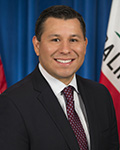
Eduardo Garcia
DDemocratic
Ask Maddy
·
AI policy assistant
Ask Maddy about AB 1639
Scope: CA
Hi! I can help you understand AB 1639. What would you like to know?
Try one of these
i
Maddy answers using official bill text and legislative records. Always verify before sharing.
Sources cited inline