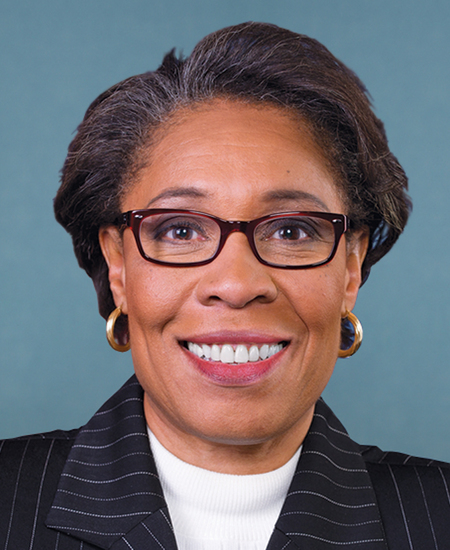
Photo of Marcia L. Fudge
D United States House · District 11 · Ohio

Rep. Marcia L. Fudge

Compare
Total votes
63
all sessions
Attendance
81%
12 missed
Lower than 98% of chamber peers
With party
98%
of cast votes
Near the chamber average
Bipartisan score
1%
crosses aisle rarely
Near the chamber average
Sponsored
11
bills & resolutions
Among the lowest in the chamber
Committees
0
assignments
11 bills and resolutions

Sponsored bills

Total
11
Primary
0
Co-sponsor
11
This page
11
matching current filters
Co-sponsor HR 1057
Signed into law · United States House · Co-sponsor
Greatest Generation Commemorative Coin Act

National World War II Memorial Commemorative Coin Act This bill directs the Department of the Treasury to mint and issue up to 50,000 $5 coins, 400,000 $1 silver coins, and 750,000 half-dollar clad coins in commemoration of the National World War II Memorial in the District of Columbia. The design of the coins shall be emblematic of the memorial and the service and sacrifice of American soldiers and civilians during World War II. All surcharges received from the sale of such coins shall be paid to the Friends of the National World War II Memorial to support the National Park Service in maintaining and repairing the memorial, and for educational and commemorative programs.

Signed into law Aug 3, 2022 1 co-sponsor
Co-sponsor HR 1448
Signed into law · United States House · Co-sponsor
PAWS for Veterans Therapy Act

Puppies Assisting Wounded Servicemembers for Veterans Therapy Act or the PAWS for Veterans Therapy Act This bill implements a program and a policy related to service dog therapy for veterans. Specifically, the bill requires the Department of Veterans Affairs (VA) to implement a five-year pilot program to provide canine training to eligible veterans diagnosed with post-traumatic stress disorder as an element of a complementary and integrative health program. Eligible veterans are those who are enrolled in the VA health care system and have been recommended for participation by a qualified mental health care provider or clinical team. The VA must seek to enter agreements containing specified elements with accredited nongovernmental entities that have demonstrated ability to provide canine training. Veterans who participate in the program are authorized to adopt the dog they assisted in training if their health provider determines it is in the best interest of the veteran. The VA must establish processes to document and track the progress of participating veterans with respect to health benefits and improvements. The Government Accountability Office must brief Congress and submit a report on the program. The bill also authorizes the VA to provide service dogs to veterans with mental illnesses, regardless of whether they have a mobility impairment.

Signed into law Aug 25, 2021 1 co-sponsor
Co-sponsor HR 1570
In committee · United States House · Co-sponsor
George Floyd Law Enforcement Trust and Integrity Act of 2021

George Floyd Law Enforcement Trust and Integrity Act of 2021 This bill requires the Department of Justice (DOJ) to take specified steps to address accreditation standards, management operations, and misconduct of law enforcement. Specifically, it requires DOJ to develop uniform accreditation standards for law enforcement agencies and adopt policies and procedures to encourage law enforcement agencies to pursue accreditation. It authorizes DOJ to make grants to law enforcement agencies to obtain accreditation from certified organizations. The bill authorizes DOJ to make grants for studying law enforcement agency management and operations standards and developing pilot programs to address law enforcement misconduct. DOJ must study the prevalence and effect of any law, rule, or procedure that allows a law enforcement officer to delay the investigation and prosecution of complaints of law enforcement misconduct. The bill also establishes the Task Force on Law Enforcement Oversight to coordinate the detection and referral of complaints of alleged law enforcement misconduct. Law enforcement agencies must report data regarding practices on traffic violation stops, pedestrian stops, frisk and body searches, and use of deadly force. Finally, DOJ must create a medallion for survivors of each law enforcement officer killed in the line of duty and memorialized on the wall of the National Law Enforcement Officers Memorial.

In committee May 18, 2021 1 co-sponsor
Co-sponsor HR 51
Passed · United States House · Co-sponsor
Washington, D.C. Admission Act

Washington, D.C. Admission Act This bill provides for admission into the United States of the state of Washington, Douglass Commonwealth, composed of most of the territory of the District of Columbia. The commonwealth shall be admitted to the Union on an equal footing with the other states. The Mayor of the District of Columbia shall issue a proclamation for the first elections to Congress of two Senators and one Representative of the commonwealth. The bill applies current District laws to the commonwealth and continues pending judicial proceedings. The commonwealth (1) shall consist of all District territory, with specified exclusions for federal buildings and monuments, including the principal federal monuments, the White House, the Capitol Building, the U.S. Supreme Court Building, and the federal executive, legislative, and judicial office buildings located adjacent to the Mall and the Capitol Building; and (2) may not impose taxes on federal property except as Congress permits. District territory excluded from the commonwealth shall be known as the Capital and shall be the seat of the federal government. The bill maintains the federal government's authority over military lands and specified other property. The bill provides for expedited consideration of a joint resolution repealing the Twenty-third Amendment to the Constitution, which provides for the appointment of electors of the President and Vice President. The bill continues certain federal authorities and responsibilities, including regarding employee benefits, agencies, courts, and college tuition assistance, until the commonwealth certifies that it is prepared to take over the authorities and responsibilities. The bill establishes the Statehood Transition Commission to advise the President, Congress, and District and commonwealth leaders on the transition.

Passed Apr 22, 2021 1 co-sponsor
Co-sponsor HR 40
In committee · United States House · Co-sponsor
Commission to Study and Develop Reparation Proposals for African Americans Act

Commission to Study and Develop Reparation Proposals for African Americans Act This bill establishes the Commission to Study and Develop Reparation Proposals for African Americans. The commission shall examine slavery and discrimination in the colonies and the United States from 1619 to the present and recommend appropriate remedies. The commission shall identify (1) the role of the federal and state governments in supporting the institution of slavery, (2) forms of discrimination in the public and private sectors against freed slaves and their descendants, and (3) lingering negative effects of slavery on living African Americans and society.

In committee Apr 14, 2021 1 co-sponsor
Co-sponsor HR 1085
Passed · United States House · Co-sponsor
To award three congressional gold medals to the United States Capitol Police and those who protected the U.S. Capitol on January 6, 2021.

This bill directs the Speaker of the House and the President pro tempore of the Senate to arrange for the award of three Congressional Gold Medals to the U.S. Capitol Police (USCP) and other law enforcement agencies that protected the U.S. Capitol on January 6, 2021. Following the award of these medals, one medal shall be given to the USCP, one medal shall be given to the Metropolitan Police Department of the District of Columbia, and one medal shall be given to the Smithsonian Institution and displayed with a plaque listing all law enforcement agencies that participated in protecting the Capitol on January 6, 2021.

Passed Mar 17, 2021 1 co-sponsor
Co-sponsor HR 5
Passed · United States House · Co-sponsor
Equality Act

Equality Act This bill prohibits discrimination based on sex, sexual orientation, and gender identity in areas including public accommodations and facilities, education, federal funding, employment, housing, credit, and the jury system. Specifically, the bill defines and includes sex, sexual orientation, and gender identity among the prohibited categories of discrimination or segregation. The bill expands the definition of public accommodations to include places or establishments that provide (1) exhibitions, recreation, exercise, amusement, gatherings, or displays; (2) goods, services, or programs; and (3) transportation services. The bill allows the Department of Justice to intervene in equal protection actions in federal court on account of sexual orientation or gender identity. The bill prohibits an individual from being denied access to a shared facility, including a restroom, a locker room, and a dressing room, that is in accordance with the individual's gender identity.

Passed Mar 17, 2021 1 co-sponsor
Co-sponsor HR 1
Passed · United States House · Co-sponsor
For the People Act of 2021

For the People Act of 2021 This bill addresses voter access, election integrity and security, campaign finance, and ethics for the three branches of government. Specifically, the bill expands voter registration (e.g., automatic and same-day registration) and voting access (e.g., vote-by-mail and early voting). It also limits removing voters from voter rolls. The bill requires states to establish independent redistricting commissions to carry out congressional redistricting. Additionally, the bill sets forth provisions related to election security, including sharing intelligence information with state election officials, supporting states in securing their election systems, developing a national strategy to protect U.S. democratic institutions, establishing in the legislative branch the National Commission to Protect United States Democratic Institutions, and other provisions to improve the cybersecurity of election systems. Further, the bill addresses campaign finance, including by expanding the prohibition on campaign spending by foreign nationals, requiring additional disclosure of campaign-related fundraising and spending, requiring additional disclaimers regarding certain political advertising, and establishing an alternative campaign funding system for certain federal offices. The bill addresses ethics in all three branches of government, including by requiring a code of conduct for Supreme Court Justices, prohibiting Members of the House from serving on the board of a for-profit entity, and establishing additional conflict-of-interest and ethics provisions for federal employees and the White House. The bill requires the President, the Vice President, and certain candidates for those offices to disclose 10 years of tax returns.


Passed Mar 11, 2021 1 co-sponsor
Co-sponsor HR 1280
Passed · United States House · Co-sponsor
George Floyd Justice in Policing Act of 2021

George Floyd Justice in Policing Act of 2021 This bill addresses a wide range of policies and issues regarding policing practices and law enforcement accountability. It increases accountability for law enforcement misconduct, restricts the use of certain policing practices, enhances transparency and data collection, and establishes best practices and training requirements. The bill enhances existing enforcement mechanisms to remedy violations by law enforcement. Among other things, it does the following: lowers the criminal intent standard—from willful to knowing or reckless—to convict a law enforcement officer for misconduct in a federal prosecution, limits qualified immunity as a defense to liability in a private civil action against a law enforcement officer, and grants administrative subpoena power to the Department of Justice (DOJ) in pattern-or-practice investigations. It establishes a framework to prevent and remedy racial profiling by law enforcement at the federal, state, and local levels. It also limits the unnecessary use of force and restricts the use of no-knock warrants, chokeholds, and carotid holds. The bill creates a national registry—the National Police Misconduct Registry—to compile data on complaints and records of police misconduct. It also establishes new reporting requirements, including on the use of force, officer misconduct, and routine policing practices (e.g., stops and searches). Finally, it directs DOJ to create uniform accreditation standards for law enforcement agencies and requires law enforcement officers to complete training on racial profiling, implicit bias, and the duty to intervene when another officer uses excessive force.

Passed Mar 9, 2021 1 co-sponsor
Showing 1 to 10 of 11 bills