

Relating to notaries public; creating a criminal offense; authorizing a fee.
SB 693 creates a new criminal offense for Texas notaries public who perform a notarization with knowledge that the person for whom the document is being notarized did not personally appear at the time of notarization. The offense is a Class A misdemeanor, but becomes a state jail felony if the document involves real estate transfer. The law includes a defense: if the person appearing presented a valid ID identifying themselves as the signer, the notary cannot be prosecuted. This bill directly affects Texas notaries by adding specific penalties for a common type of notarial fraud.
Bill status
signed
all 5 stages cleared
Introduction
Jan 2025
Committee Review
May 2025
Senate Passage
May 2025
House Passage
May 2025
Signed into Law
May 2025
Introduced Jan 3, 2025
Signed May 30, 2025
Maddy AI version diff · 2 comparisons
What changed between versions
Engrossed
→
Enrolled
·
3 edits
·
May 21, 2025
MINOR
The bill was finalized and formatted for official enactment, with minor formatting cleanup and one substantive addition to the education requirements. The main policy change is that notary education courses must now be provided exclusively by the Secretary of State, whereas previously third-party providers were allowed. This centralizes control over notary training in the state.
Scope change
The bill's scope remains focused on notary public qualifications and offenses, but the education provision now restricts who can provide training courses.
REQUIREMENT
Education course providers changed from allowing third-party providers to requiring that all courses be established and offered only by the Secretary of State.
TECHNICAL
Minor formatting cleanup including removal of placeholder text, standardization of spacing, and proper alignment of bill sections.
Added a note about digital content accessibility alignment with WCAG 2.1 standards at the top of the enrolled version.
Floor votes · House May 12, 2025
How they voted
This bill passed the Senate by voice vote (no roll call recorded).
Full legislative history
Actions timeline
Total actions
58
Key actions
17
Committee
11
Amendments
7
May 21, 2025
Lower · Passed
Signed in the House
lower
May 21, 2025
Upper · Passed
Signed in the Senate
upper
May 21, 2025
Introduced
Senate concurs in House amendment(s)-reported
lower
May 20, 2025
Introduced
Senate concurs in House amendment(s)
upper
May 20, 2025
Introduced
House amendment(s) laid before the Senate
upper
May 14, 2025
Upper · Passed
House passage as amended reported
upper
May 13, 2025
Lower · Passed
Passed
lower
May 12, 2025
Lower · Passed
Committee report sent to Calendars
lower
May 12, 2025
Lower · Passed
Committee report distributed
lower
May 12, 2025
House · Passed
House Vote: pass (103-35-6)
house
May 8, 2025
Lower · Passed
Reported favorably as substituted
lower
May 8, 2025
Lower · Passed
Vote reconsidered in committee
lower
May 1, 2025
Lower · Passed
Reported favorably as substituted
lower
Apr 17, 2025
Committee
Referred to Judiciary & Civil Jurisprudence
lower
Apr 17, 2025
Introduced
Read first time
lower
Apr 10, 2025
Introduced
Received from the Senate
lower
Apr 9, 2025
Upper · Passed
Passed
upper
Apr 9, 2025
Upper · Passed
Passed to engrossment as amended
upper
Apr 9, 2025
Upper · Passed
Amended
upper
Apr 9, 2025
Introduced
Amendment(s) offered
upper
Mar 31, 2025
Upper · Passed
Committee report printed and distributed
upper
Mar 31, 2025
Upper · Passed
Reported favorably as substituted
upper
Mar 25, 2025
Upper · Passed
Vote taken in committee
upper
Mar 25, 2025
Upper · Passed
Testimony taken in committee
upper
Feb 3, 2025
Committee
Referred to Criminal Justice
upper
Feb 3, 2025
Introduced
Read first time
upper
5 primary · 0 co-sponsors
Sponsors
Role
Legislator
Party
State
District
P

Joe Moody
DDemocratic
P

Mike Schofield
RRepublican
P

Oscar Longoria
DDemocratic
P
RA
Rafael Anchía
DDemocratic
P
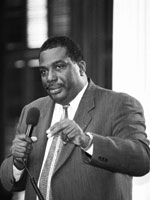
Royce West
DDemocratic
Ask Maddy
·
AI policy assistant
Ask Maddy about SB 693
Scope: TX
Hi! I can help you understand SB 693. What would you like to know?
Try one of these
i
Maddy answers using official bill text and legislative records. Always verify before sharing.
Sources cited inline