

Maddy summaryPennsylvania House Bill 2750 creates a new legal category called "microenterprise home kitchen operations," allowing individuals to register their primary residences to produce and sell specific homemade food items directly to consumers. The bill defines eligible products as those prepared in a standard residential kitchen with a single stove or oven, while explicitly excluding low-acid canned goods, alcoholic beverages, smoked or cured meats, and other high-risk foods. To support these small-scale businesses, the legislation prohibits local regulators from requiring commercial-grade equipment, structural modifications to the home, or the removal of pets from non-preparation areas. Operators must still comply with food safety certifications and pay a licensing fee capped at $50, but they are restricted to selling directly to consumers rather than through other retail stores.
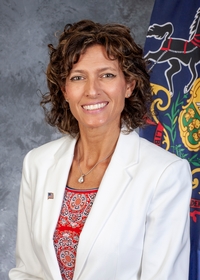
Rep. Leslie Rossi
Sponsored bills
Maddy summaryHB 158, the "Fairness in Women's Sports Act," requires public schools and colleges in Pennsylvania to explicitly designate athletic teams as male, female, or coed based on biological sex. It prohibits teams designated for females from allowing male students to participate and allows students who face denied opportunities or harm due to violations to sue for damages. Schools can also sue entities that punish them for following the law. The bill applies directly to all public school districts, colleges, and athletic programs covered under Pennsylvania's Public School Code.
Maddy summaryThis bill introduces a new junior driver's license for 16 and 17-year-olds in Pennsylvania, which automatically converts to a regular license at age 18. Under the proposed rules, junior drivers would generally be prohibited from driving between 11 p.m. and 5 a.m. unless accompanied by a parent, spouse, or guardian. However, the legislation creates an exception allowing these drivers to drive during those hours for school-sponsored activities if they possess a letter from the school confirming the event. If a junior driver is stopped by police without this letter but can later prove they had it, the charges would be dismissed. The law also defines terms like "school-sponsored activity" to include events such as field trips, athletic activities, and club meetings.
Maddy summaryHR 362 is a procedural resolution that directs the House to discharge the Committee on Education from further consideration of House Bill 158, allowing HB 158 to move directly to the full House floor for a vote. This action bypasses the committee's review process, which typically requires committee approval before a bill can be debated on the floor. The resolution was placed on the calendar under Rule 53 on October 29, 2025, signaling it will now proceed to a floor vote. This change affects the legislative workflow for HB 158 but does not alter the content or policy of HB 158 itself.
Maddy summaryHB 788 amends Pennsylvania's Tax Reform Code of 1971 to adjust tax rates for mutual thrift institutions (like credit unions and mutual banks) operating in the state. It gradually reduces their annual tax rate from 8.99% in 2025 down to 4.99% by 2033, with specific rates set for each year through 2033. The bill also extends the period for carrying forward net losses from three to ten years when calculating tax deductions. This directly affects mutual thrift institutions by lowering their tax burden over time and changing how they can offset past losses against current income.
Maddy summaryHR 340 is a procedural resolution that removes Senate Bill 186 from the Committee on Environmental and Natural Resource Protection, requiring the committee to cease further consideration of the bill. This allows Senate Bill 186 to move directly to the full House for debate and a vote. The resolution was placed on the calendar under Rule 53 on October 8, 2025, as part of the legislative process to advance stalled bills. It does not change policy but addresses a procedural delay in the committee.
Maddy summaryHR 339 is a procedural resolution that removes the House Committee on Health from further consideration of Senate Bill No. 9, allowing the full House to directly debate and vote on that bill. This action bypasses the committee's usual role in reviewing legislation. The bill was added to the calendar for floor consideration under Rule 53 on October 8, 2025, moving it closer to a full vote. It does not change policy but alters the legislative process for Senate Bill No. 9.
Maddy summaryThis procedural bill removes the Committee on Intergovernmental Affairs and Operations from further consideration of House Resolution 278. It allows House Resolution 278 to move directly to the full House for debate and voting under Rule 53, bypassing the committee review process. The bill itself does not change policy but alters the legislative path for another resolution.
Maddy summaryHB 2000 designates a specific section of highway in Pennsylvania as the "Pennsylvania and National Medal of Honor Highway" to honor Medal of Honor recipients. It directly affects the highway corridor by renaming it, replacing a previous designation. The bill's key provision is the repeal of the prior highway name, formally establishing this new commemorative name through legislative action. This is a ceremonial measure with no funding or policy changes beyond the highway's official designation.
Maddy summaryHB 157 creates state grants to help healthcare entities in rural counties or designated medically underserved areas cover the student loan debt of their employed healthcare practitioners. The grants would be paid directly to the healthcare facilities (like clinics or hospitals), not to individual providers, to offset the cost of practitioners' education debt. This aims to support recruitment and retention of healthcare workers in areas with limited access to medical services. The program would be funded through state appropriations, targeting facilities serving communities with significant healthcare access challenges.