

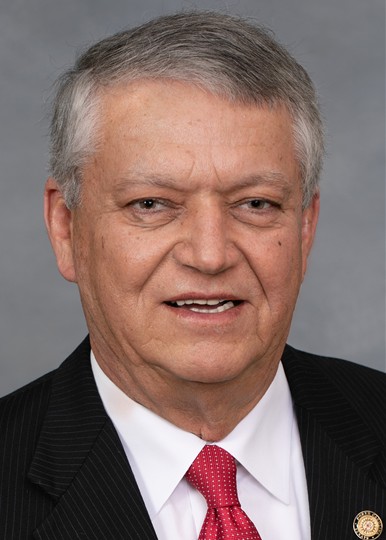
Photo of Norman Sanderson
R North Carolina Senate · District 2 On the 2026 ballot

Sen. Norman Sanderson

Compare
Total votes
3,634
all sessions
Attendance
99%
21 missed
Higher than 77% of chamber peers
With party
98%
of cast votes
Near the chamber average
Bipartisan score
1%
crosses aisle rarely
Near the chamber average
Sponsored
776
bills & resolutions
Higher than 77% of chamber peers
Committees
15
assignments
776 bills and resolutions

Sponsored bills

Total
776
Primary
93
Co-sponsor
683
This page
776
matching current filters
Co-sponsor SB 403
Failed · North Carolina Senate · Co-sponsor
Additional Medicaid Funds and Requirements.

Maddy summarySB 403 (North Carolina) prepares the state for potential federal approval of Medicaid work requirements. It requires the Department of Health and Human Services (DHB) to negotiate with the Centers for Medicare and Medicaid Services (CMS) if work requirements become authorized, and to notify specific legislative committees within 30 days of starting talks. After CMS approves a plan, DHB must submit a detailed report to those committees, including implementation dates and funding needs. The bill does not create new requirements but establishes a process for the state to implement them if federally approved. This is a procedural measure affecting Medicaid administration, not the current benefit structure.

Failed Aug 6, 2026 1 co-sponsor
Co-sponsor SB 857
Signed into law · North Carolina Senate · Co-sponsor
GSC Update Funeral Board and DOI Licensing.

Maddy summarySB 857 updates the statutes governing the North Carolina Board of Funeral Service and amends various licensing programs within the Department of Insurance. The bill primarily reorganizes existing laws by recodifying sections to improve clarity and adds new definitions for terms such as alkaline hydrolysis, funeral chapels, and embalming facilities. These changes clarify what constitutes a funeral establishment versus a separate chapel or embalming site and specify how certain religious or private preparations are treated. The legislation affects funeral directors, embalmers, and related businesses by refining the rules they must follow regarding facility operations and terminology.

Signed into law Jul 8, 2026 1 co-sponsor
Co-sponsor SB 474
Signed into law · North Carolina Senate · Co-sponsor
Adjust Counties/Reappraisal Moratorium.

Maddy summarySB 474, the DAVE Act, creates a new Division of Accountability, Value, and Efficiency within North Carolina's State Auditor's office. It requires all state agencies to report by October 2025 on how they spend public funds and list vacant positions held for six months or longer, including reasons for vacancies. The Division will assess whether agencies or specific positions remain necessary, using AI tools to analyze spending effectiveness, duplication, and budget use. By December 2025, the Division must recommend to the legislature which agencies or positions should be eliminated based on this review.

Signed into law Jul 8, 2026 1 co-sponsor
Co-sponsor SB 355
Signed into law · North Carolina Senate · Co-sponsor
Support the Dept. of Adult Correction.-AB

Maddy summarySB 355 waives tuition at North Carolina public colleges for survivors of correctional officers, probation officers, or firefighters who died in the line of duty or became permanently disabled. It specifically covers spouses of disabled officers and children (ages 17-24) of disabled officers, with eligibility requiring service-connected death/disability and verification from relevant agencies. The waiver applies to both credit and noncredit programs, limiting bachelor’s degree support to 54 months. This policy directly affects families of these public safety workers by reducing education costs.

Signed into law Jul 8, 2026 1 co-sponsor
Co-sponsor SB 1041
Signed into law · North Carolina Senate · Co-sponsor
Public Workforce Modernization Act.

Maddy summaryThis bill establishes a new chapter in North Carolina law to modernize and simplify the state's human resources system for employees in state agencies and universities. It creates a decentralized system under the Governor's direction where agency heads are responsible for managing their own personnel, while the Office of State Human Resources provides oversight. The legislation sets core principles for the workforce, including equal opportunity, fair compensation, and clear accountability, and it defines specific categories of employees such as career and temporary staff. Additionally, the bill appropriates funds to support these modernization efforts and clarifies the roles of various government bodies within the new framework.

Signed into law Jul 7, 2026 1 co-sponsor
Co-sponsor SB 257
Signed into law · North Carolina Senate · Co-sponsor
2026 Appropriations Act.

Maddy summarySB 257, the 2025 Appropriations Act, allocates funding for North Carolina's state agencies, departments, and institutions for the 2025-2027 fiscal biennium. It provides budget authority from the General Fund, Highway Fund, and Highway Trust Fund to cover current operations, maintenance, and specific programs like those managed by the Department of Transportation. The bill also includes federal block grant funding for health and human services (DHHS) and other designated programs. This funding measure directly affects all state entities receiving these appropriations and becomes effective July 1, 2025.

Signed into law Jul 7, 2026 1 co-sponsor
Co-sponsor SB 1076
Signed into law · North Carolina Senate · Co-sponsor
Rocky Mount/Louisburg Utility Rev./Advisory.

Maddy summaryThis bill restricts the City of Rocky Mount from using money earned by its electric utility to fund general city expenses beyond specific operational needs. It mandates that revenue from electric rates must primarily cover the costs of running the power system, paying off related debts, and keeping rates low for customers. The only exception allows the city to transfer a limited amount of surplus funds to other municipal accounts, capped at the greater of 3% of the system's assets or 5% of its annual revenue. Effective July 1, 2026, these rules apply exclusively to Rocky Mount, preventing the transfer of electric utility profits to the city's general fund for unrelated purposes.

Signed into law Jul 2, 2026 1 co-sponsor
Co-sponsor SB 992
Passed · North Carolina Senate · Co-sponsor
Truth in Taxation.

Maddy summaryThis bill, titled "Truth in Taxation," requires local taxing authorities in North Carolina to follow a specific process before raising property tax rates above a revenue-neutral level during years when a general reappraisal of real property occurs. To implement this change, the governing body must publish public notices in newspapers and online, send direct mail to taxpayers detailing the proposed tax increase, and hold a dedicated public hearing where a majority vote is required to approve the higher rate. If a local government fails to comply with these procedures and collects excess taxes, the bill mandates that they refund the overage to affected property owners. Additionally, the legislation increases the late reinstatement fee for expired real estate appraiser trainee registrations, licenses, and certificates to $12 per month, up from $10.

Passed Jul 1, 2026 1 co-sponsor
Co-sponsor SB 808
Passed · North Carolina Senate · Co-sponsor
Board of Cosmetic Art Examiners Amendments.

Maddy summaryThis bill modifies North Carolina's Cosmetic Art Act to create a new professional category called "hair designer" specifically for natural hair care services. It reduces the training hours required to become a licensed cosmetologist and removes the apprenticeship requirement for licensure. The legislation also formally defines "natural hair care" as services that involve tension on hair strands through twisting, wrapping, extending, or locking. These changes aim to deregulate certain hair care practices while establishing new licensing pathways for specialists in that field.

Passed Jun 30, 2026 1 co-sponsor
Co-sponsor SB 1001
Passed · North Carolina Senate · Co-sponsor
Coastal Regulatory Reform.

Maddy summarySB 1001 modifies North Carolina's coastal regulations to streamline permit processes and update requirements for specific marina projects. The bill clarifies that sending certified mail to adjacent landowners satisfies notice requirements for development permits, ensuring these applications are not delayed by non-responses. It also amends rules for upland basin marinas by allowing site-specific modeling to prove sufficient water flushing instead of mandating mechanical aeration, while simultaneously requiring financial bonds or set-aside funds to cover five years of maintenance costs. Additionally, the legislation expands the uses of the Coastal Storm Damage Mitigation Fund to include the construction and repair of terminal groins for local governments that benefit public lands. Finally, the bill includes several technical corrections to existing statutes regarding vessel capacity definitions and policy goal references.

Passed Jun 30, 2026 1 co-sponsor
Showing 1 to 10 of 776 bills
1 2 3 78 Next