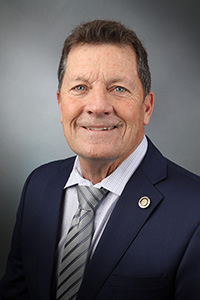
Photo of Mike Henderson
R Missouri Senate · District 3

Sen. Mike Henderson

Compare
Total votes
0
all sessions
Attendance
-
of floor votes
With party
0%
of cast votes
Bipartisan score
0%
crosses aisle rarely
Sponsored
98
bills & resolutions
Committees
4
assignments
98 bills and resolutions

Sponsored bills

Total
98
Primary
90
Co-sponsor
8
This page
98
matching current filters
Primary SB 1135
Signed into law · Missouri Senate · Lead sponsor
Creates "Bentley and Mason's Law" relating to child maintenance orders for certain persons convicted of the offense of driving while intoxicated

Maddy summarySB 1135, known as "Bentley's Law," requires courts to mandate child support payments for parents convicted of driving while intoxicated (DUI) who already have existing child support obligations. The bill directs judges to include specific child maintenance requirements in sentencing or court orders for these individuals. It directly affects parents with children who face DUI convictions and fail to meet current child support duties. The key provision ensures child support is formally integrated into DUI-related legal proceedings without requiring separate court action.

Signed into law Jul 13, 2026 0 co-sponsors
Primary SB 1067
Signed into law · Missouri Senate · Lead sponsor
Establishes the Uniform Public Expression Protection Act, which provides procedures for dismissal of actions based on public expression

SB 1067 - This act establishes the "Uniform Public Expression Protection Act". Currently, any action against a person for conduct or speech undertaken or made in connection with a public hearing or meeting in a quasi-judicial proceeding before a tribunal or decision-making body of the state or a political subdivision thereof is subject to a special motion to dismiss, a motion for judgment on the pleadings, or motion for summary judgment and any such motion shall be considered by the court on a priority or expedited basis. This act repeals this provision and creates procedures for dismissal of causes of action asserted in a civil action based on a person's: (1) Communication in a legislative, executive, judicial, administrative, or other governmental proceeding; (2) Communication on an issue under consideration or review in a legislative, executive, judicial, administrative, or other governmental proceeding; or (3) Exercise of the right of freedom of speech or of the press, the right to assemble or petition, or the right of association, guaranteed by the United States Constitution or the Missouri Constitution, on a matter of public concern. However, this act shall not apply to a cause of action asserted: (1) Against a governmental unit, as described in the act, or an employee or agent of a governmental unit acting in an official capacity; (2) By a governmental unit or an employee or agent of a governmental unit acting in an official capacity to enforce a law to protect against an imminent threat to public health or safety; or (3) Against a person primarily engaged in the business of selling or leasing goods or services if the cause of action arises out of a communication related to the sale or lease of such goods or services. No later than 60 days after a party is served with a complaint, cross-claim, counterclaim, third-party claim, or other pleading that asserts a cause of action covered by this act, or at a later time upon a showing of good cause, a party may file a special motion to dismiss. The court shall hear and rule on such motion no later than 60 days after the filing of the motion, unless the court orders a later hearing to allow for limited discovery or upon good cause. However, this act provides that the court shall hear and rule on the motion for dismissal no later than 60 days after the order allowing for discovery. This act provides that all other proceedings between the moving party and the responding party in the action, including discovery and any pending hearings or motions, shall be stayed upon the filing of the special motion to dismiss. Additionally, this act provides that the court may stay, upon motion by the moving party, a hearing or motion involving another party or discovery by another party if a ruling on such hearing or motion or discovery relates to a legal or factual issue. Any stay pursuant to this act shall remain in effect until the entry of an order ruling on the special motion to dismiss and the expiration of the time to appeal the order. A moving party may appeal an order denying the special motion to dismiss in whole or in part within 21 days of such order. If a party appeals an order ruling on a special motion to dismiss, this act provides that all proceedings between all parties shall be stayed until the conclusion of the appeal. The court may allow discovery if a party shows that specific information is necessary to establish whether a party has satisfied or failed to satisfy the requirements of this act and such information is not reasonably available without discovery. Additionally, a motion for costs and expenses, voluntary dismissal, or a motion to sever shall not be stayed. During a stay, the court upon good cause may hear and rule on any motions unrelated to the special motion to dismiss and any motions seeking a special or preliminary injunction to protect against an imminent threat to public health or safety. In ruling on a special motion to dismiss, this act provides that the court shall consider the parties' pleadings, the motion, any replies and responses to the motion, and any evidence that could be considered in a ruling on a motion for summary judgment. The court shall dismiss the cause of action with prejudice if: (1) The moving party has established that the cause of action is covered by this act; (2) The responding party has failed to establish that this act does not apply to the cause of action; and (3) Either the responding party failed to establish a prima facie case as to each essential element of the cause of action, or the moving party has established that the responding party failed to state a cause of action upon which relief can be granted or that there is no genuine issue as to any material fact and that the party is entitled to judgment as a matter of law. A voluntary dismissal without prejudice of a cause of action that is subject to a special motion to dismiss pursuant to this act shall not affect the moving party's right to obtain a ruling on the motion and seek costs, reasonable attorneys' fees, and reasonable litigation expenses. Additionally, if the moving party prevails on the motion, this act provides that such costs, fees, and expenses shall be awarded to the moving party. A voluntary dismissal with prejudice of a cause of action that is subject to a special motion to dismiss establishes that the moving party prevailed on the motion. The responding party shall be entitled to such costs, fees, and expenses if the responding party prevails on the motion and the court finds that the motion was frivolous or filed solely with the intent to delay the proceeding. Finally, this act applies to causes of action filed or asserted on or after August 28, 2026. This act is identical to provisions in the truly agreed to and finally passed CCS/HCS/SS/SCS/SBs 835 & 1111 (2026), in SCS/SB 1468 (2026), SB 503 (2025), in SCS/HCS/HB 615 (2025), in SCS/HCS/HB 1259 (2025), and SB 1293 (2024) and is substantially similar to HB 2666 (2026), provisions in HCS/HB 83 (2025), in SCS/HCS/HB 176 (2025), in SB 352 (2025), HB 1092 (2025), in SCS/SB 897 (2024), HB 1785 (2024), in SCS/HCS/HB 2064 & HCS#2/HB 1886 (2024), in CCS/HCS/SS/SCS/SB 72 (2023), SB 432 (2023), HB 750 (2023), SB 1219 (2022), in HCS/SS#2/SCS/SB 968 (2022), HB 2624 (2022), and HB 1151 (2021). KATIE O'BRIEN


Signed into law Jul 13, 2026 0 co-sponsors
Primary SB 1572
Signed into law · Missouri Senate · Lead sponsor
Modifies provisions relating to public employee retirement systems

Maddy summarySB 1572 modifies rules governing members of the Board of Trustees for the Police Retirement System of St. Louis. The bill's abstract does not specify the exact changes to board membership provisions, such as appointment terms, qualifications, or voting procedures. As introduced (first read January 20, 2026) and referred to committee, it has not yet been debated or amended. This procedural bill affects the governance structure of the retirement system but does not alter benefit calculations or funding. No concrete policy changes are described in the provided context.

Signed into law Jul 9, 2026 0 co-sponsors
Primary SB 903
Signed into law · Missouri Senate · Lead sponsor
Modifies and creates new provisions relating to telecommunications infrastructure

Maddy summaryThis bill updates laws protecting telecommunications infrastructure by expanding the definition of critical infrastructure facilities and creating new criminal offenses for damaging or stealing equipment. It makes it a felony to purposely or recklessly damage critical infrastructure that causes service interruptions, regardless of the damage value, and establishes penalties for unauthorized possession of copper, brass, aluminum, fiber, or other telecom materials. The law requires offenders to pay restitution and perform community service, while allowing prosecutors to charge under multiple applicable laws if conduct violates more than one provision. These changes directly affect individuals who might damage or steal telecom equipment and law enforcement agencies responsible for investigating such crimes.

Signed into law Jul 9, 2026 0 co-sponsors
Primary SB 1605
In committee · Missouri Senate · Lead sponsor
Makes 7-hydroxymitragynine in certain amounts a Schedule I controlled substance

Maddy summarySB 1605 would classify 7-hydroxymitragynine (a compound found in kratom) as a Schedule I controlled substance in the state when present in specified amounts. This bill directly affects individuals possessing or distributing this compound above the defined threshold. The key provision would subject such possession or distribution to the same strict legal penalties as other Schedule I drugs, such as heroin or LSD. The bill is currently in its initial stage (first reading) and has not yet been debated or voted on.

In committee May 15, 2026 0 co-sponsors
Primary SB 994
Passed · Missouri Senate · Lead sponsor
Modifies provisions relating to taxation

Maddy summarySB 994 modifies Missouri's income tax return filing rules. It sets the deadline for filing state income tax returns to match the federal deadline under 26 U.S.C. 6072 (typically April 15), requiring payment by that date without additional notices. It also adds a provision preventing penalties or interest for taxpayers denied tax credits due to funding shortages, provided they pay within 60 days of the denial notice. This bill directly affects Missouri taxpayers and the Department of Revenue, changing filing deadlines and credit dispute procedures.

Passed May 15, 2026 0 co-sponsors
Primary SB 1196
Passed · Missouri Senate · Lead sponsor
Modifies provisions relating to grants for certain workforce training programs

Maddy summaryThis bill (SB 1196) modifies grant provisions for specific workforce training programs, but the provided context lacks details on the exact changes or who is directly affected. The official abstract and recent actions (prefiled December 2025, first reading January 2026) do not specify key mechanisms, program eligibility, or affected groups. Without additional information on the proposed modifications, a substantive summary of policy changes cannot be provided. As a procedural bill with minimal detail in the context, a full summary cannot be generated.

Passed May 15, 2026 0 co-sponsors
Primary SB 1481
In committee · Missouri Senate · Lead sponsor
Modifies provisions relating to wireless emergency telephone service charges

SB 1481 - Current law imposes a prepaid wireless emergency telephone service charge equal to three percent of the retail transaction, with the first $15 of each transaction exempt from the charge. This act repeals the exemption for the first $15 of each transaction and, beginning January 1, 2027, increases the service charge to four percent. The act also requires the Director of Revenue to require a seller to report the number of retail transactions as well as the total dollar amount of each transaction and the total amount of prepaid wireless emergency telephone service charges collected. Current law allows a seller to deduct and retain three percent of the service charges that are collected by the seller. Beginning January 1, 2027, this act increases such amount to four percent. If the Director of Revenue determines that a seller has not collected the required amount of services charges, the seller shall not be permitted to deduct and retain any amount of the services charges, nor shall the seller be permitted to deduct and retain any amount of sales taxes allowable under current law. This act is substantially similar to HB 2767 (2026). JOSH NORBERG

In committee May 15, 2026 0 co-sponsors
Primary SB 1730
In committee · Missouri Senate · Lead sponsor
Modifies provisions relating to the Missouri Technology Corporation

Maddy summaryThis bill's abstract states it "modifies provisions relating to the Missouri Technology Corporation" but provides no specific details about the changes. The available context only lists the bill title, a generic abstract, and its status (S First Read on 2026-02-25). No concrete policy changes, affected parties, or key mechanisms are described in the provided information. Without further details on the specific provisions being modified, a substantive summary cannot be generated.

In committee May 7, 2026 0 co-sponsors
Primary SB 1700
In committee · Missouri Senate · Lead sponsor
Requires school districts and charter schools to install master key boxes at public schools and charter schools on or before July 1, 2028

Maddy summarySB 1700 requires all public school districts and charter schools in the state to install master key boxes at every school campus by July 1, 2028. These boxes would provide emergency responders with immediate access to locked areas during crises, such as active threats or medical emergencies. The bill directly affects school administrators and facility managers, who must coordinate the installation and maintenance of these security devices. It establishes a clear deadline for compliance without specifying additional funding or enforcement mechanisms.

In committee May 7, 2026 0 co-sponsors
Showing 1 to 10 of 98 bills
1 2 3 10 Next