

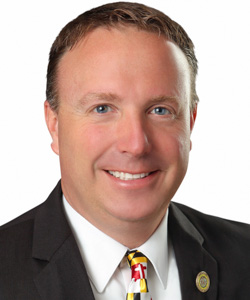
Photo of Jeff Ghrist
R Maryland House · District 36 On the 2026 ballot

Rep. Jeff Ghrist

Compare
Total votes
11,895
all sessions
Attendance
91%
1,100 missed
Lower than 93% of chamber peers
With party
96%
of cast votes
Lower than 78% of chamber peers
Bipartisan score
2%
crosses aisle rarely
Higher than 76% of chamber peers
Sponsored
492
bills & resolutions
Lower than 86% of chamber peers
Committees
5
assignments
492 bills and resolutions

Sponsored bills

Total
492
Primary
309
Co-sponsor
183
This page
492
matching current filters
Primary HB 1599
Signed into law · Maryland House · Lead sponsor
Chesapeake Bay - Enhancement Program and Maryland Seafood Industry Financial Assistance Fund - Established

Maddy summaryHB 1599 establishes Maryland's Chesapeake Bay Enhancement Program within the Department of Natural Resources. The program provides $2 million annually (starting fiscal year 2028) from the Transportation Trust Fund to fund oyster propagation and replenishment projects. These projects specifically mitigate harm to the state's oyster population caused by transportation projects at the Helen Delich Bentley Port of Baltimore, including dredging, pier/bridge construction, and channel maintenance. The law requires the Governor to include this funding in the annual budget bill, directly affecting oyster restoration groups and transportation project developers needing to offset environmental impacts.

Signed into law May 12, 2026 0 co-sponsors
Primary HB 461
Signed into law · Maryland House · Lead sponsor
Economic Development - Rural Readiness Program and Rural Maryland Capacity Building Fund - Establishment

Maddy summaryHB 461 establishes the Rural Readiness Program, administered by the Rural Maryland Council, to help rural communities improve their capacity for economic development. It also creates a permanent Rural Maryland Capacity Building Fund to provide grants for planning and capacity-building initiatives. The program assists eligible applicants - including local governments, nonprofits, tribal organizations, and regional planning agencies - with grant applications and project development. Successful participants receive a completion certificate that grants them priority for three specific state grant programs focused on rural economic growth.

Signed into law May 12, 2026 0 co-sponsors
Primary HB 569
Signed into law · Maryland House · Lead sponsor
Queen Anne's County - Authorized Uses of Revenues From Development Impact Fees - Expansion

Maddy summaryHB 569 allows Queen Anne's County Commissioners to use revenue from development impact fees for capital costs related to replacing public school facilities. Previously, these fees could only fund specific infrastructure projects, but this bill expands their allowable use to include school building replacements. The change modifies Maryland's local government code (Section 20-706) to explicitly authorize this new purpose for Queen Anne's County. The bill takes effect July 1, 2026.

Signed into law May 12, 2026 0 co-sponsors
Primary HB 1400
Signed into law · Maryland House · Lead sponsor
Shellfish Aquaculture - Penalties - Suspension or Revocation of Permit or Registration Card

Maddy summaryHB 1400 creates penalties for shellfish aquaculture permit and registration card holders who violate specific regulations. It directly affects commercial shellfish harvesters in Maryland who hold these permits. Key violations include harvesting oysters too close to closed areas, using prohibited gear, exceeding time restrictions, harvesting from leased areas without authorization, or taking oysters commercially without proper permits. For a first violation, permits may be suspended for up to 5 years; repeat violations result in permanent revocation. During suspension or revocation, individuals cannot work in any aquaculture activity, even if unrelated to shellfish.

Signed into law Apr 28, 2026 0 co-sponsors
Primary HB 1395
Signed into law · Maryland House · Lead sponsor
Consumer Protection - Agricultural Equipment Warranties

Maddy summaryHB 1395 requires farmers who purchase new agricultural equipment to provide written notice (via certified mail) to manufacturers or dealers about defects during the warranty period. It mandates that manufacturers or dealers correct defects within 30 days at no cost to the farmer, even if repairs occur after the warranty expires. If repeated repair attempts fail to fix issues that substantially impair the equipment’s use or value, farmers can choose a replacement or refund. The bill applies to self-propelled farm vehicles (excluding lawn mowers, ATVs, or off-road vehicles) sold on or after January 1, 2026, and makes warranty violations subject to enforcement under Maryland’s Consumer Protection Act.

Signed into law Apr 28, 2026 0 co-sponsors
Primary HB 1559
Signed into law · Maryland House · Lead sponsor
Children in Unlicensed Settings and Pediatric Hospital Overstay Patients - Placement

Maddy summaryThis bill prohibits placing children in unlicensed settings (such as hotels, motels, or nonresidential offices) under Maryland's out-of-home placement program for foster care, with limited exceptions for kinship caregivers or parental placements. It creates a new Child and Youth Placement Review Panel within the Governor’s Office to oversee placements and requires the Placement Manager to convene a Rapid Response Team for urgent cases. The bill also establishes an Advisory Council to improve Maryland’s system of care for children and families and modifies hospital overstay protocols for pediatric patients. These changes directly affect children in foster care, hospitals, and the agencies managing their care, aiming to ensure safer, licensed placements.

Signed into law Apr 28, 2026 0 co-sponsors
Primary HB 972
Signed into law · Maryland House · Lead sponsor
Maryland Fair and Agricultural Education Promise Fund - Establishment ( Charles J. Otto Agricultural Education Promise Act)

Maddy summaryHB 972 establishes the Maryland Fair and Agricultural Education Promise Fund, a permanent fund to provide annual grants supporting agricultural fairs and education. The fund will receive lottery proceeds (before allocation to the general fund) and replace previous requirements for horse racing fund allocations. It directs specific annual grants: $825,000 to the Maryland Agricultural Fair Board, $75,000 to the Maryland Agricultural Education Foundation, $550,000 to the Maryland State Fair Society (for youth programs like 4-H and FFA), and $50,000 to the Maryland FFA Association. These grants aim to advance agricultural fairs, education, and youth programs across Maryland.

Signed into law Apr 28, 2026 0 co-sponsors
Primary HB 980
Signed into law · Maryland House · Lead sponsor
Family Law and Human Services - Guardianship Assistance Program and State Foster Youth Ombudsman - Establishment (Kanaiyah's Law)

Maddy summaryHB 980 (Kanaiyah's Law) creates the Office of the Child Welfare Ombudsman within the Attorney General's office to handle complaints about Maryland's child welfare system. It requires juvenile courts to include specific information-sharing requirements in guardianship orders and expands criminal background checks to cover all adults living in a child's guardian's home. The bill also prohibits unlicensed placements for certain children, protects complainants from retaliation, and exempts certain complaint records from public disclosure. These changes directly affect child welfare agencies, guardians, and families navigating the system, aiming to improve transparency and accountability.

Signed into law Apr 28, 2026 0 co-sponsors
Primary HB 535
Signed into law · Maryland House · Lead sponsor
Food Establishments - Cottage Food Businesses - Maximum Annual Revenue

Maddy summaryHB 535 increases the maximum annual revenue limit for cottage food businesses in Maryland from $50,000 to $100,000. This change directly affects home-based food producers who sell nonhazardous, packaged foods (like baked goods or jams) from their residences or through approved channels such as farmers markets, retail stores, or direct delivery. The bill revises existing law to allow these small-scale businesses to generate higher sales while still qualifying as cottage food operations under state regulations. It does not alter the types of foods permitted or the sales channels, only the revenue threshold for eligibility. The change takes effect October 1, 2026.

Signed into law Apr 28, 2026 0 co-sponsors
Primary HB 613
Signed into law · Maryland House · Lead sponsor
Department of the Environment - Waivers for Living Shorelines and Nonstructural Shoreline Stabilization Measures - Regulations and Scoring System

Maddy summaryHB 613 requires property owners in Calvert and St. Mary's Counties to use natural erosion control methods (like marsh creation, native plants, and oyster reefs) instead of hard structures (such as seawalls) for shoreline stabilization. It exempts these counties from general state requirements for nonstructural measures and creates a new waiver process where owners must demonstrate to the Department of Natural Resources that natural methods are not feasible due to factors like extreme erosion or narrow shorelines. The bill defines "living shorelines" as projects using natural materials and ecological principles to absorb wave energy and restore habitats, while still allowing structural measures in specific high-energy areas. This directly affects property owners along navigable waters in those two counties, changing how they must address shoreline erosion.

Signed into law Apr 28, 2026 0 co-sponsors
Showing 1 to 10 of 492 bills
1 2 3 50 Next