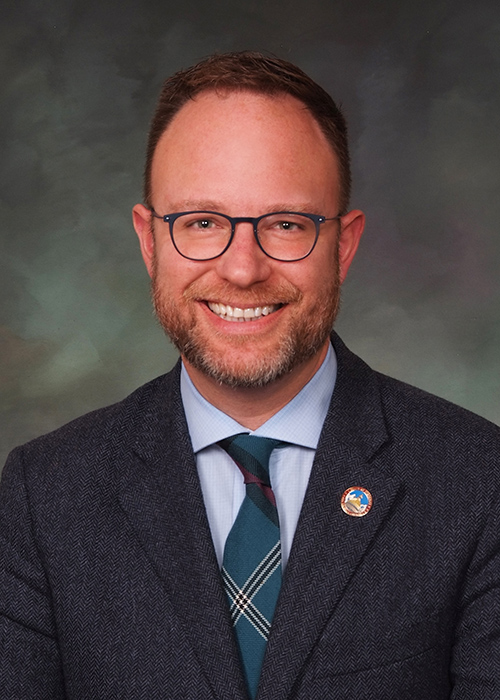
Photo of Matt Soper
R Colorado House · District 54

Rep. Matt Soper

Compare
Total votes
5,732
all sessions
Attendance
94%
334 missed
Lower than 91% of chamber peers
With party
85%
of cast votes
Lower than 88% of chamber peers
Bipartisan score
9%
crosses aisle rarely
Higher than 87% of chamber peers
Sponsored
450
bills & resolutions
Near the chamber average
Committees
6
assignments
450 bills and resolutions

Sponsored bills

Total
450
Primary
301
Co-sponsor
149
This page
450
matching current filters
Primary HB 1431
Signed into law · Colorado House · Lead sponsor
Competency for Occupational Licensure Portability

Under existing law, an individual licensed, certified, registered, or enrolled in good standing to practice a particular profession or occupation in another state or United States territory or through the federal government is eligible to apply for and receive a license, certification, registration, or enrollment in that profession or occupation in Colorado (accreditation) if the individual meets specific criteria. The act adds an individual licensed, certified, registered, or enrolled in good standing to practice a particular profession or occupation in another country to those individuals eligible for accreditation if the individual meets specific criteria.(Note: This summary applies to this bill as enacted.)

Signed into law Jun 4, 2026 0 co-sponsors
Primary HB 1432
Signed into law · Colorado House · Lead sponsor
Health-Care Payment Programs

The act repeals the health-care delivery system reform incentive payments program in the Colorado healthcare affordability and sustainability enterprise (enterprise) and creates the hospital quality incentive program (incentive program) to use enterprise hospital provider fee revenue to make additional payments to hospitals that meet performance metrics in delivering safer and more effective care that improves patient outcomes and reduces preventable utilization to reduce health-care costs. Prior to implementing the program, the enterprise board shall approve the percentage of hospitals' reimbursement in the incentive program and the incentive program structure, performance measures, and scoring methodology. Once the incentive program is implemented, the total amount of payments made under the incentive program must not exceed 9% of the total reimbursements made to hospitals in the previous state fiscal year.(Note: This summary applies to this bill as enacted.)

Signed into law Jun 4, 2026 0 co-sponsors
Primary HB 1417
Signed into law · Colorado House · Lead sponsor
Colorado Anti-Discrimination Act Testing Entities

Current law requires a testing entity to provide accommodations for an individual with a disability who is taking an exam for professional licensing. The current definition of 'testing entity' includes a private entity or a state or local governmental entity offering such an exam and having control over testing accommodation decisions.     The act changes the definition of 'testing entity' to include any person, business, or state or local government agency that offers an examination or course related to an application, license, certification, or credential for secondary or postsecondary education, professional, or trade purposes. The act further requires a testing entity to offer the exam or course in a place and manner that is accessible to an individual with a disability or offer an alternative accessible arrangement in order to accommodate an individual with a disability who has met the requirements to receive the accommodation.(Note: This summary applies to this bill as enacted.)

Signed into law Jun 4, 2026 0 co-sponsors
Co-sponsor HB 1325
Signed into law · Colorado House · Co-sponsor
Natural Medicine

The act establishes the ibogaine research pilot program (pilot program) in the behavioral health administration (BHA) to research the safety and effectiveness of using ibogaine to treat mental health conditions and substance use disorders. The act requires the BHA to establish a committee to review pilot program site applications and make recommendations to the BHA on which applicants to accept. The BHA may select up to 5 ibogaine pilot sites. The act allows the BHA to seek, accept, and expend gifts, grants, and donations and establishes the ibogaine research pilot program cash fund. The pilot program is contingent on the BHA receiving sufficient gifts, grants, and donations to administer the pilot program and award grants to the selected ibogaine pilot sites to help with financing needs.     Under current law, the division of natural medicine advisory board consists of 15 voting members, 8 of whom must have general expertise and experience related to natural medicine and 7 of whom must have specialized expertise and experience in various areas of natural medicine. The act amends the expertise and experience requirements to apply equally to all 15 voting members.     The act adds that a facilitator of natural medicine services is not liable for a physical or psychological injury that a participant may experience as a result of the facilitator's performance or supervision of the natural medicine services that a participant receives, unless the injury is the result of the facilitator's intentional misconduct, gross negligence, or a deviation from the recognized standard of care.     The act authorizes the state licensing authority for natural medicine or natural medicine product (state licensing authority) to adopt rules related to the administration, manufacturing, and use of ibogaine.     The act sets requirements for how the state licensing authority must prioritize reviewing applications for licensure to facilitate natural medicine services and allows the state licensing authority to set different licensing fees depending on the type of natural medicine the applicant is seeking licensure for.     The act allows the state licensing authority to accept gifts, grants, and donations from public or private sources and requires gifts, grants, or donations received to be deposited in the regulated natural medicine division cash fund.     The act requires the BHA to work to secure federal research and development funding available through the advanced research projects agency for health within the federal department of health and human services, or other available funding, in order to advance research on the use of ibogaine for the treatment of serious mental illness.     The act updates the powers and duties of the director of the division of professions and occupations to include adopting rules that guide the use and administration of ibogaine.     A licensee seeking to cultivate, manufacture, dispense, or administer ibogaine shall, in consultation with Indigenous communities, establish a benefit-sharing plan that directly benefits those Indigenous communities.     The act:Updates definition of 'administration session' to include the use of regulated natural medicine and regulated natural medicine product that the participant purchases to consume during the administration session;Prohibits a person from advertising bona fide harm reduction services or bona fide support services offered for remuneration, advertising natural medicine or natural medicine products, or using harm reduction services or support services to conduct sales of natural medicine;Clarifies that the state licensing authority is not required to conduct routine, periodic, or pre-operational inspections as a condition of licensure unless expressly required;Requires state licensing authority to adopt rules regarding licensing privileges and restrictions of a limited regulated natural medicine sales license and eligibility requirements for an applicant to obtain a limited regulated natural medicine sales license;Allows the state licensing authority to adopt rules regarding the application procedures and license requirement for a healing center to operate a temporary premises; and requirements for cultivation, manufacture, testing, or dispensing of ibogaine;Allows the department of public health and environment to issue a temporary premises permit to a licensed natural medicine healing center if certain conditions are met and allows a healing center to apply for a temporary premises permit;Prohibits a healing center licensee from selling regulated natural medicine or regulated natural medicine product unless a co-located limited regulated natural medicine sales licensee conducts the transaction in accordance with certain requirements; andAllows the director of the natural medicine division to issue an order to cease and desist if the director determines that a person is acting or has acted without a license to operate a natural medicine business or to own, grow, harvest, transfer, manufacture, supervise, provide, or administer natural medicine.(Note: This summary applies to this bill as enacted.)


Signed into law Jun 4, 2026 1 co-sponsor
Co-sponsor HB 1250
Signed into law · Colorado House · Co-sponsor
Procedures Related to Civil Asset Forfeiture

The act clarifies an existing requirement for the criminal conviction of a property owner by requiring that one or more criminal charges be brought as a prerequisite to any nuisance abatement or forfeiture proceeding.     Existing law provides an exception to the conviction requirement for noninnocent owners who are not subject to criminal charges that no criminal conviction is necessary of the nonowner criminal defendant if the plaintiff proves its case by clear and convincing evidence that the property subject to the forfeiture proceeding is traceable proceeds of the charged offense or related criminal activity. The act clarifies this exception to first require a conviction of the nonowner criminal defendant before the noninnocent owner's property may be forfeited, while retaining other various exceptions that allow forfeiture actions to proceed against the interest of a claimant.     The act establishes a right for indigent civil asset forfeiture defendants to access forfeiture defense counsel and creates a procedure for the appointment of forfeiture defense counsel in nuisance abatement and forfeiture proceedings. The state court administrator shall enter into a contract for services with a private contractor who regularly provides legal services for indigent clients or litigants to provide a legal defense to a civil asset forfeiture proceeding. The private contractor is subject to certain reporting requirements.     The act creates a forfeiture defense counsel fund (fund) to pay for contracted forfeiture defense counsel who are authorized to represent persons against whom a nuisance abatement or forfeiture proceeding has been filed in connection with criminal charges. The fund is capped at $500,000, and starting in state fiscal year 2027-28, no general fund money is allowed to finance the fund. The balance of the fund over $500,000 is credited to the law enforcement community services grant program fund. The act transfers any unexpended and unencumbered money from the law enforcement community services grant program fund to the forfeiture counsel defense fund.     The act alters the disposition of property and proceeds ordered forfeited in a nuisance abatement or forfeiture action. Currently, forfeited property and proceeds are applied first toward restitution and cost recovery for a list of stakeholders, and of the remainder, 50% is granted to the local governmental body with authority over the seizing agency, 25% is granted to the local behavioral health administrative services organization, and 25% is granted to the law enforcement community services grant program fund. The act amends the disposition of the remainder so that 50% is granted to the local governmental body with authority over the seizing agency, 25% is granted to the fund, and 25% is granted to the local behavioral health administrative services organization.     The act appropriates $556,750 to the judicial department from the fund for civil asset forfeiture defense contracting and $55,000 to the department of local affairs from the fund for civil asset forfeiture portal administration.(Note: This summary applies to this bill as enacted.)
Signed into law Jun 4, 2026 1 co-sponsor
Primary SB 132
Signed into law · Colorado Senate · Lead sponsor
Voluntary Alcohol Breath Test

Maddy summarySB 132, known as the "Magnus Law," requires Colorado law enforcement officers to offer drivers involved in collisions resulting in death or suspected serious injury the opportunity to voluntarily take a breath test for alcohol. The bill mandates officers provide clear, plain-language advisement that the test is voluntary, refusal carries no penalty, and results cannot be used in court. It applies when officers reasonably suspect the driver was at fault and the driver isn't critically injured, creating a standardized protocol to ensure consistent investigation of potential impairment at serious crash scenes. This change aims to preserve evidence that might otherwise be lost, without altering existing legal standards for driving under the influence.

Signed into law Jun 4, 2026 0 co-sponsors
Co-sponsor HB 1033
Signed into law · Colorado House · Co-sponsor
Expanding the Colorado Cottage Foods Act

The act expands the 'Colorado Cottage Foods Act' (CCFA) by allowing for the sale of homemade foods that require refrigeration and foods that include meat and meat products. A producer of a food (producer) that requires time and temperature control must take a food safety course that includes food handling training concerning time and temperature control and acquire and maintain proof of course completion.     A producer selling products that require time and temperature control for safety may sell one type of such food product, with the ability to offer up to 5 variations of that one type of food product. The producer must specify the individual food products that require time and temperature control for safety and provide a list of such food products to the department of public health and environment (department) or a county, district, or regional health agency (public health agency) upon request.     A producer selling products under the CCFA is required to register with the department before selling. The department must issue a registration number to each producer and maintain an electronic registry of producers. A producer may earn up to $150,000 of net revenues under the CCFA each calendar year, increased from $10,000 . The department is required to adjust this cap annually for inflation.     The act authorizes a public health agency that inspects or investigates homemade food products produced pursuant to the CCFA to impose a fine for a violation of the requirements of the CCFA and to recover the cost of the inspection or investigation. If a public health agency determines that, on 3 separate occasions within 12 months, a producer has misbranded food that requires time and temperature control for safety or failed to comply with requirements related to food that requires time and temperature control for safety, the producer shall not sell foods that require time and temperature control.     The act creates the cottage foods cash fund (cash fund) and transfers $300,000 into the cash fund ($200,000 from the medication administration cash fund and $100,000 from the assisted living residence cash fund). The act also appropriates $119,354 to the department to implement the act.(Note: This summary applies to this bill as enacted.)

Signed into law Jun 4, 2026 1 co-sponsor
Co-sponsor HJR 1030
Passed · Colorado House · Co-sponsor
Mono & Matt Road Designation

Maddy summaryThis bill designates a two-mile stretch of Colorado Highway 14 in Weld County as 'Mono & Matt Road' to honor Edwardo 'Mono' Hernandez and Matthew Garcia, two high school basketball players who died in a 2014 traffic accident. The legislation authorizes the Colorado Department of Transportation to install signs for the new name and allows the department to accept donations for this purpose while exploring a cooperative agreement with Weld County for future maintenance. By placing the names on a specific roadway, the bill creates a permanent physical tribute to the students in the location where the accident occurred.

Passed Jun 3, 2026 1 co-sponsor
Co-sponsor HJR 1031
Passed · Colorado House · Co-sponsor
2027 Session Convening Date & Deadlines

Maddy summaryThis bill sets the official start date for Colorado's 2027 legislative session to Monday, January 11, 2027, and establishes a detailed schedule of deadlines for introducing and passing laws. It directly affects state legislators and legislative staff by creating a new set of rules that specify when bills must be filed, introduced, and passed by various committees. The bill includes specific dates for actions such as submitting bill drafts, introducing new legislation, and final passage, with special provisions for school funding bills and appropriation bills. These deadlines are designed to organize the legislative process and ensure timely completion of the session's work.

Passed Jun 3, 2026 1 co-sponsor
Co-sponsor HR 1007
Passed · Colorado House · Co-sponsor
Colorado 150th Anniversary

Maddy summaryHR 1007 is a commemorative resolution honoring Colorado's 150th anniversary of statehood in 2026. The bill directly affects the people of Colorado and various government officials by formally recognizing the state's history, culture, and achievements. Its key provisions call on citizens to celebrate this milestone with gratitude and dedication to liberty while committing to preserve natural resources, promote civic education, and strengthen infrastructure. The resolution does not create new laws or funding but serves as a symbolic acknowledgment of the state's legacy and future goals.

Passed Jun 3, 2026 1 co-sponsor
Showing 1 to 10 of 450 bills
1 2 3 45 Next